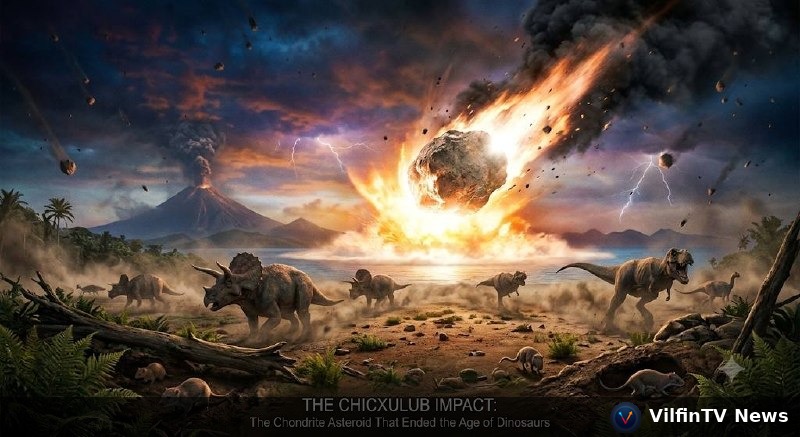
For more than 40 years, scientists have agreed on the basics of the story: 66 million years ago, a giant space rock slammed into what is now Mexico's Yucatan Peninsula, wiping out the dinosaurs and roughly three-quarters of all species on Earth. What they couldn't agree on was exactly what kind of rock it was — and that detail matters more than it sounds, because it changes how the killing actually happened.
A new study, published July 17, 2026 in the journal Science Advances, says it has finally pinned it down. By measuring nickel isotopes (versions of the nickel atom with slightly different weights) preserved in rock layers laid down right at the moment of impact, researchers led by Georgy Makhatadze identified the impactor as a CO chondrite — an exceptionally rare type of "carbonaceous" (carbon-rich) meteorite that makes up only about 5% of all space rocks that fall to Earth.
Why the Rock Type Changes the Whole Story
A "chondrite" is a primitive, unmelted meteorite — basically a leftover chunk from the raw material that built the solar system 4.5 billion years ago, never cooked into a planet. Different chondrite families carry very different chemical fingerprints, including wildly different amounts of sulfur.
That sulfur number turns out to be the whole ballgame. For years, the leading theory blamed the mass extinction mostly on sulfur: the impact was thought to have vaporized huge amounts of sulfur-rich rock, shooting sulfate particles into the upper atmosphere that blocked sunlight and acidified rain for years, similar to (but far worse than) a massive volcanic eruption.
But CO chondrites are unusually poor in sulfur and other volatile elements. "A CO chondrite contains much less volatile elements — particularly sulfur," said study co-author Prof. Philippe Claeys. If the impactor itself was this low in sulfur, the sulfur-aerosol theory loses its main fuel source. Instead, the researchers argue, it was the sheer volume of fine dust and pulverized debris thrown into the atmosphere — blocking sunlight and shutting down photosynthesis worldwide for months to years — that was the primary driver of the "impact winter" that killed off the dinosaurs.
Don't Confuse This With Two Other Recent Studies
This finding has good company but is easy to mix up with two other real, separate pieces of research on the same asteroid:
- Fischer-Gödde et al., Science, August 2024 — used a different element (ruthenium isotopes) and established only that the impactor was a carbonaceous chondrite in general, without narrowing down the specific CO subtype.
- Rodiouchkina et al., Nature Communications, January 2025 — found that the Yucatan bedrock itself (the target the asteroid hit, not the asteroid), released about 5 times less sulfur than earlier models assumed. That's a separate mechanism — about the ground being hit, not the rock doing the hitting — that happens to point in the same "dust over sulfur" direction.
The new nickel-isotope study is the first to specifically identify the asteroid itself as a CO chondrite, adding a second, independent line of evidence — from the impactor's own chemistry this time — for why dust and darkness, not sulfuric acid rain, likely did the most damage to life on Earth.
What Comes Next
The team says more nickel-isotope sampling of the boundary layer at other sites worldwide could confirm how uniform this signature is globally, and refine climate models of exactly how dark and cold the post-impact years actually got.