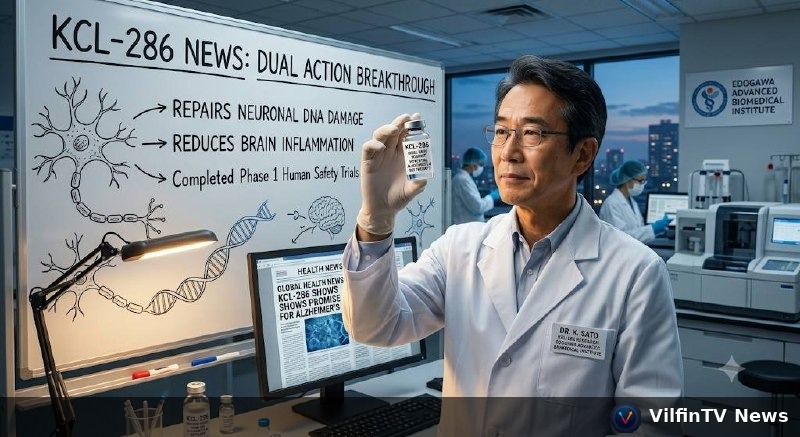
Somewhere in a lab at King's College London, a molecule built for a completely different job just wandered into the fight against Alzheimer's — and it might be exactly what the brain's broken repair crew has been waiting for.
The molecule is called KCL-286. It wasn't designed with Alzheimer's in mind at all — it was originally built to treat spinal cord injuries, and had already been through a human safety trial for that purpose. That's the twist: a drug meant to help snapped nerves in the spine may end up helping snapped DNA in the brain instead.
The Real Villain: Broken DNA, Not Just Plaques
For two decades, Alzheimer's research has circled around one main suspect: sticky amyloid plaques clogging up the brain like grease in old pipes. But a team led by Prof. Jonathan Corcoran at King's College London went looking somewhere else — inside the DNA of brain cells themselves.
What they found, in a mouse model of Alzheimer's, was serious damage: double-strand breaks, the most severe kind of DNA injury there is. Think of your genetic code as a twisted ladder; a double-strand break is that ladder getting sawed clean through, not just scuffed. Left unrepaired, that kind of damage piles up and pushes brain cells toward dysfunction and death.
KCL-286 is a first-in-class RARβ agonist — plain English: it switches on a receptor (RARβ) that acts like a foreman for the cell's repair machinery. Treated mice showed less of this DNA damage and calmer, less inflamed brain tissue than untreated ones. In a disease that has spent years attacking the wrong wall, that's a genuinely different tool in the box.
Why "Already Safety-Tested" Is a Big Deal — But Not a Shortcut to the Finish Line
Here's the part worth getting excited about, carefully: because KCL-286 already passed a Phase 1 human safety trial for spinal cord injury, researchers already know a fair amount about how it behaves in real people — dosing, tolerability, side effects. That safety data doesn't vanish just because the target disease changed, and it can genuinely shave time off future development.
But — and this is the part headlines love to skip — that trial was for spinal cord injury, not Alzheimer's. No human Alzheimer's trial has started yet. Everything about DNA repair and reduced inflammation described above happened in mice, not people. "Already safety-tested" is a real head start, not a finish line already in sight.
Don't Confuse This With Lecanemab or Donanemab
If you've heard Alzheimer's drug news in the last few years, it was probably about lecanemab or donanemab — antibody drugs, given by IV infusion, that work by clearing amyloid plaques out of the brain. Those are already approved in several countries and target the "plaques" side of the disease.
KCL-286 is a different animal entirely: a small-molecule pill-style approach (not an antibody), aimed at DNA damage and inflammation rather than plaque removal. It's not a competitor to those drugs so much as a completely different angle of attack — which is exactly why researchers are interested, since amyloid-clearing drugs alone haven't been the complete answer many hoped for.
What Comes Next
The next real test is whether KCL-286 can make the jump from mouse brains to human Alzheimer's trials — and whether the DNA-repair and anti-inflammatory effects seen in mice hold up in people. That's still an open question. But for a field that has leaned on one theory for twenty years, a genuinely new mechanism with a head start on safety data is worth watching closely.
This is preclinical (mouse-model) research, not a human Alzheimer's treatment — not medical advice.