
Picture an Indian family gathering. On one side, Reliance, HDFC Bank and Bharti Airtel — the "eldest sons of the house" — have grabbed the mic and refuse to let go, hogging the entire stage. The other 47 relatives barely get a word in. That, roughly, is the personality of Nifty 50. Now picture a more "democratic" version of the same gathering, where everyone gets exactly equal mic time — that's Nifty 50 Equal Weight. Today we're putting these two "family squabbles" — sorry, indices — through a full, honest comparison to figure out which one is actually better for your money.
What Are These Two Indices, Really?
Nifty 50 is the index of the 50 largest companies on the NSE — but "largest" here means weighted by market capitalisation. That means giants like Reliance carry an outsized influence over the entire index's movement.
Nifty 50 Equal Weight uses the exact same 50 companies — but gives each one roughly 2% weight (1/50), equally. NSE "rebalances" this every six months (in June and December), resetting any stock whose weight drifted up or down due to price moves back to 2%.
Top 10 Stocks: Who Actually Controls the Index?
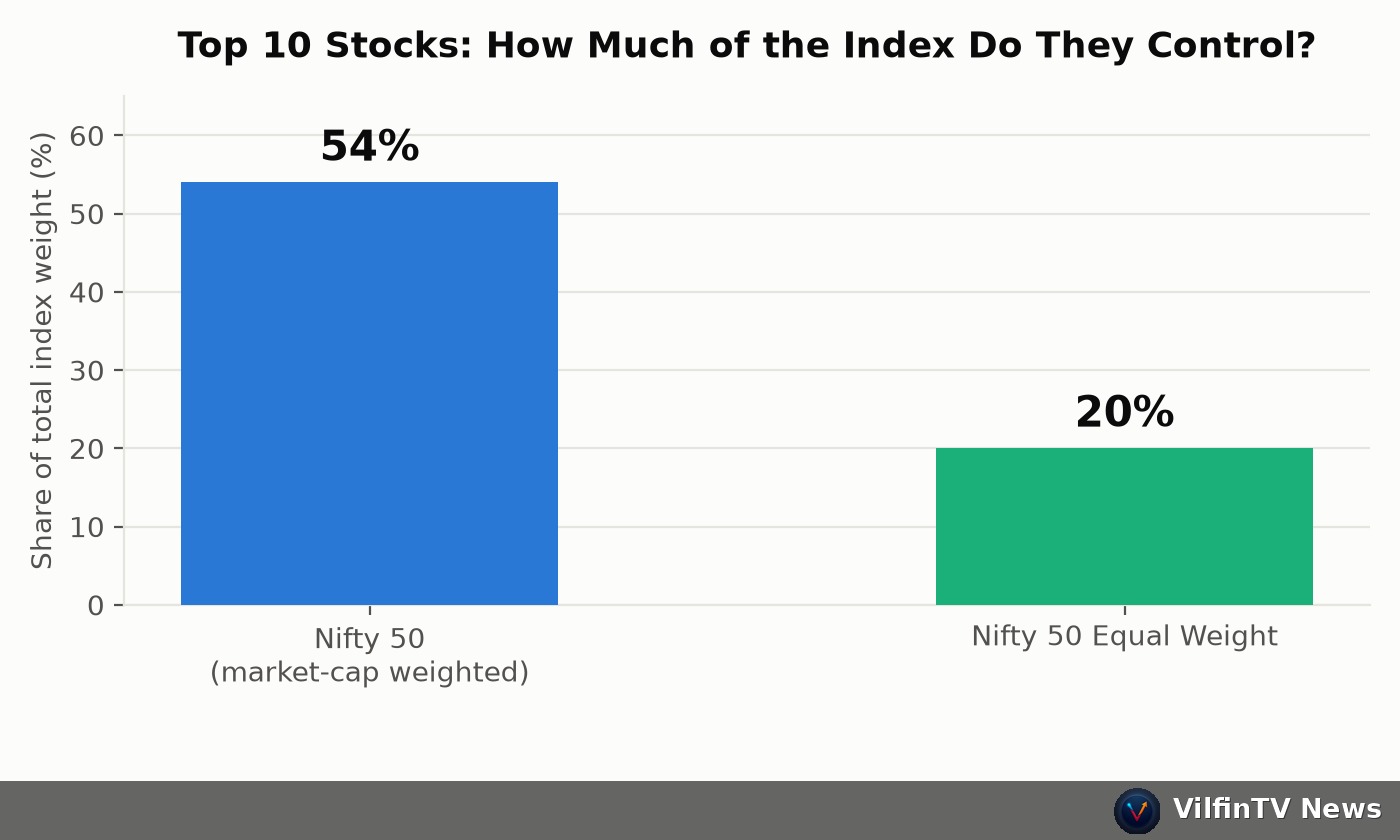
This is the single most important difference. In the standard Nifty 50, the top 10 stocks together control roughly 54% of the index's total weight — meaning the remaining 40 companies combined get just 46%. In Nifty 50 Equal Weight, the math guarantees the top 10 stocks can never exceed exactly 20% (10 × 2%). That structural cap is what protects the index from being dragged down by any single company's bad news.
Same Stock, Two Very Different Worlds
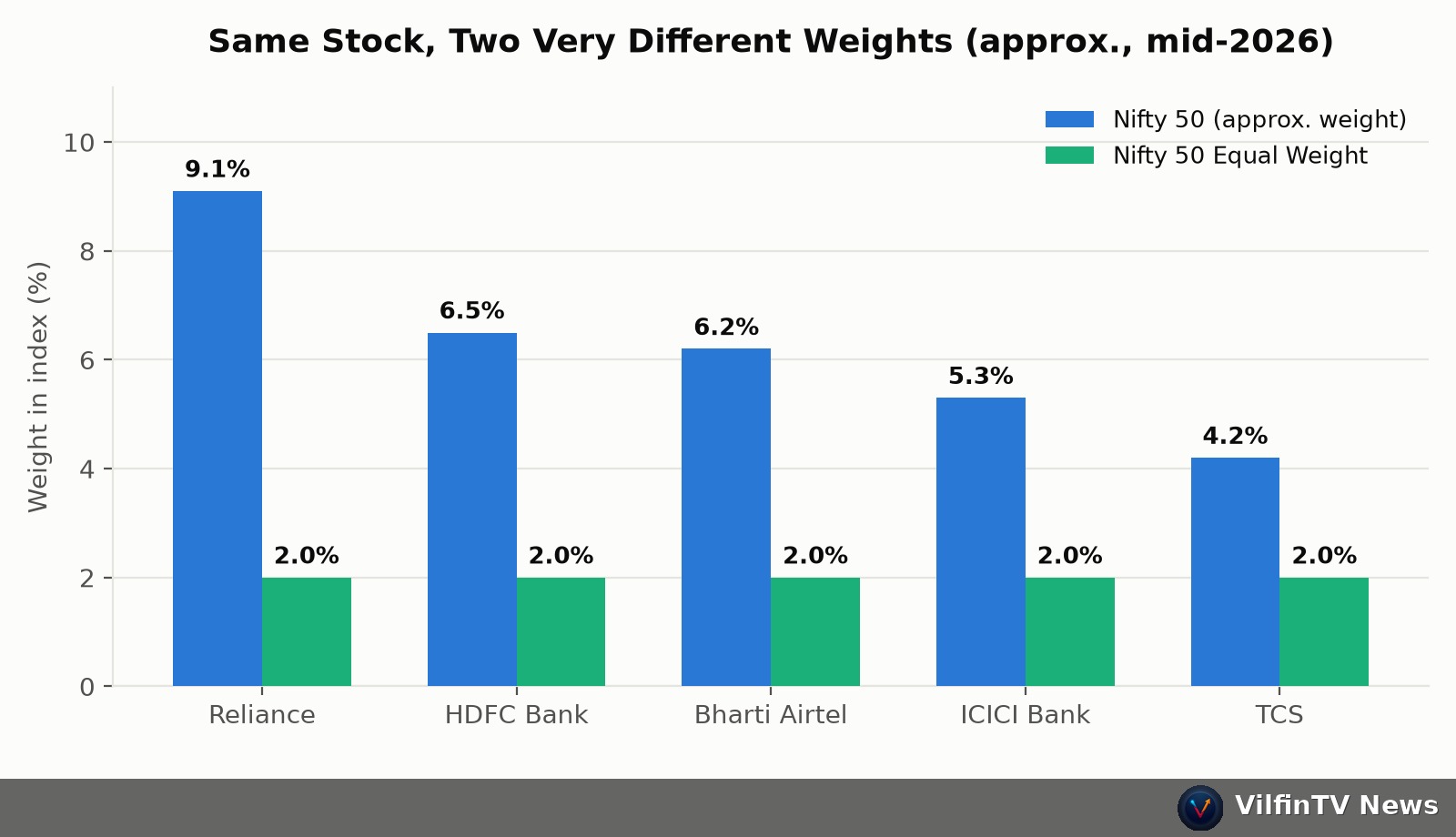
Look at this chart — Reliance carries roughly 9% weight in the standard Nifty 50, but goes on a forced "diet" down to just 2% in the Equal Weight version! HDFC Bank and Bharti Airtel get the same treatment. It's a bit like a financial yoga class — everyone gets stretched to the same position, nobody gets to hog the mat.
| Stock | Weight in Nifty 50 (approx.) | Weight in Equal Weight |
|---|---|---|
| Reliance Industries | ~9.1% | ~2.0% |
| HDFC Bank | ~6.5% | ~2.0% |
| Bharti Airtel | ~6.2% | ~2.0% |
| ICICI Bank | ~5.3% | ~2.0% |
| State Bank of India | ~5.0% | ~2.0% |
| TCS | ~4.2% | ~2.0% |
| Bajaj Finance | ~3.4% | ~2.0% |
| Larsen & Toubro | ~2.7% | ~2.0% |
| Hindustan Unilever | ~2.6% | ~2.0% |
| Sun Pharma | ~2.4% | ~2.0% |
Note: these percentages are approximate, mid-2026 figures — stock prices move daily, so actual weights shift slightly. Check niftyindices.com for exact current figures.
What Does History Actually Say? (An Honest Answer)
This is exactly where a lot of YouTube "finance gurus" start lying to you. "Equal Weight always wins" gets claimed constantly — but reality is far less dramatic. Looking at the last 10 years of data, the two indices have run an almost dead-heat race — across rolling 10-year windows, Equal Weight came out slightly ahead roughly 52% of the time, with standard Nifty 50 ahead the rest. In other words, it's close to a coin flip, not a guaranteed winner. On risk, Equal Weight carries a bit more mid-cap tilt, so there is some difference — but again, nothing dramatically wide.
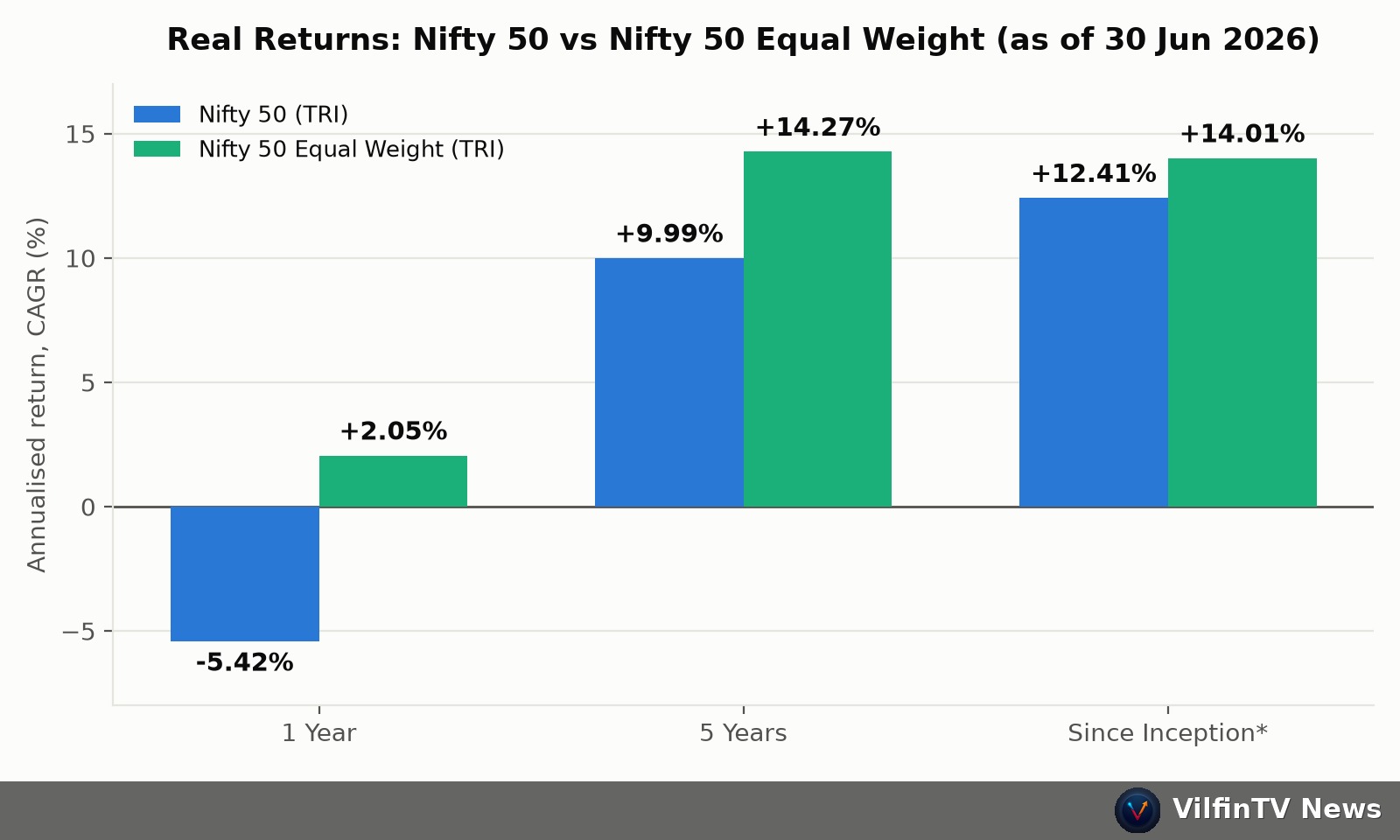
Looking at NSE's official factsheets (TRI figures as of 30 June 2026), the recent picture looks like this: over the last one year, standard Nifty 50 lost -5.42% while Equal Weight held on to a +2.05% gain. Over 5 years, Equal Weight (14.27%) is ahead of standard Nifty 50 (9.99%), and on a "since inception" basis Equal Weight (14.01%) also holds a small lead over 12.41% — though remember the two indices have different inception dates, so this isn't a perfectly clean apples-to-apples comparison. NSE's current factsheet format doesn't publish 3-year or 10-year figures anymore — better to say so honestly than to guess at numbers that aren't published.
Where to Actually Invest: Real ETFs and Funds
| Index | Fund/ETF Name | Approx. Expense Ratio |
|---|---|---|
| Nifty 50 | Nippon India ETF Nifty BeES | ~0.04% |
| Nifty 50 | ICICI Prudential Nifty 50 ETF | ~0.02% |
| Nifty 50 | UTI Nifty 50 ETF | ~0.05% |
| Nifty 50 | SBI Nifty 50 ETF | ~0.03–0.04% |
| Nifty 50 Equal Weight | ICICI Prudential Nifty50 Equal Weight Index Fund | ~0.35–1.0% (depending on plan) |
| Nifty 50 Equal Weight | DSP Nifty 50 Equal Weight ETF (EQUAL50ADD) | Low ETF-tier rate |
| Nifty 50 Equal Weight | SBI Nifty50 Equal Weight ETF (SBINEQWETF) | Low ETF-tier rate |
| Nifty 50 Equal Weight | Motilal Oswal Nifty 50 Equal Weight ETF (MON50EQUAL) | Low ETF-tier rate |
Expense ratio is the small annual percentage a fund charges from your investment to manage it — lower is better, since more of the gains stay in your pocket over time. Check the AMC's own factsheet for the exact current figure before buying.
Forecast: What Happens Next?
Let's be upfront — nobody can precisely forecast the stock market's future, and you shouldn't trust anyone who claims otherwise! That said, a few general observations: analysts who believe India's economy will spread its growth across more sectors, rather than staying concentrated in a handful of giants, tend to favour Equal Weight. But during periods of global uncertainty, investors typically flock back toward the large, stable companies (Nifty 50's "eldest sons"). In short: both have their moment, and neither wins forever.
How to Actually Buy: A Simple Path
For an ETF, you can buy it just like any regular stock, through a demat/trading account. For an index fund, you can invest via a mutual fund platform, either as an SIP or a lump sum:
- To buy an ETF (trading account): Open a demat + trading account with Zerodha or Dhan, then search the ticker (e.g. NIFTYBEES or SBINEQWETF) and place your order.
- To buy an index fund (SIP/lump sum): Buy direct plans at zero commission via Kuvera.
- For high-volume traders: Consider ProStocks' flat-fee plan.
🎁 Using the referral links above benefits you at no extra cost.
Which One's Better? An Honest Answer
This isn't a simple "one is always better" answer. If you place more trust in India's biggest names like Reliance and HDFC Bank, a standard Nifty 50 ETF with a low expense ratio like Nippon India ETF Nifty BeES suits you. But if you want a more diversified portfolio that doesn't lean too heavily on any single company or sector, Nifty 50 Equal Weight (e.g. the DSP or SBI Equal Weight ETF) is a solid choice. Plenty of investors hold both together in smaller proportions — that's not a bad idea either!
Conclusion
Here's the final word: Nifty 50 is a movie where "a handful of superstars hog every spotlight"; Nifty 50 Equal Weight is the ensemble-cast film where "everyone gets one line each." Both are good movies — which one you prefer depends on your own risk appetite and goals. Either way, don't forget to do your homework before booking the ticket — that is, before you invest!
Disclaimer: This article is for informational and educational purposes only and does not constitute investment advice. Please consult a licensed financial advisor before making any investment decisions.