
Ever walked into a new restaurant, stared at the menu, and frozen up trying to decide what to order? That's exactly what it feels like the first time you step into the stock market — thousands of companies, no idea what to buy, head spinning. This is exactly where ETFs and index funds ride in as rescuers — like a "combo meal" that orders the whole menu in one go. Today, let's fully understand what these are, how to get started, and how dividends actually work — no jargon, kept simple.
First: What Is an "Index"?
An index is essentially a "top list" — for example, Nifty 50 is a list of India's 50 largest companies. The index reduces the combined average performance of those 50 companies down to a single number. Think of it like a cricket team's average score — the performance of all 11 players combined into one overall picture.
What Is an Index Fund?
An index fund is a mutual fund — except instead of a fund manager personally deciding "which stock to buy," it simply copies the index exactly as-is. A Nifty 50 index fund, for example, buys all 50 of those companies in the same proportion. You can buy it just like any regular mutual fund, via the AMC's website or app, as an SIP or a lump sum — no need to watch "trading hours," orders are processed once a day based on NAV.
What Is an ETF?
An ETF (Exchange Traded Fund) is the same basic idea — a fund that copies an index — except it's listed on the NSE/BSE just like a regular stock. That means you can buy and sell it anytime during trading hours (9:15 AM to 3:30 PM) at live market prices — which requires a demat + trading account.
ETF vs. Index Fund: What's the Difference?
| Factor | ETF | Index Fund |
|---|---|---|
| How You Buy It | Like a stock, during trading hours | Via the AMC/app, once a day at NAV |
| Account Needed | Demat + trading account required | No demat needed, a folio is enough |
| Is SIP Possible? | Difficult directly (possible via some brokers' auto-order feature) | Easy, monthly auto-SIP |
| Expense Ratio | Usually the lowest (~0.02–0.05%) | Slightly higher (~0.1–0.4%) |
| Price | Price of a single unit (a small amount is enough) | Any amount (from ₹100) |
| Liquidity | Low-volume ETFs can have a wider bid-ask spread | Always redeemable at NAV price |
In short: ETFs suit those who already have a trading account and want the lowest possible cost; index funds suit those who want an easy SIP without needing a demat account.
Dividends: How Do You Actually Get Them From an ETF/Index Fund?
This is the part most people get wrong. When Reliance or HDFC Bank declares a dividend, that money does go to the ETF/index fund — but it does not land directly in your bank account. Instead, that dividend amount gets reinvested right back inside the fund, nudging the fund's NAV up slightly. This is what's known as the "Growth" option — and it's how almost every Indian ETF works by default.
There's a technical term worth knowing here too — TRI vs. PRI: the standard "Nifty 50" index (Price Return Index / PRI) doesn't account for dividends at all, it only shows price movement. But "Nifty 50 TRI" (Total Return Index) shows the real return after dividends are reinvested — naturally a bit higher. SEBI rules require every mutual fund to benchmark its performance against the TRI version — so don't be surprised to see "benchmark: Nifty 50 TRI" on a fund's factsheet; that's the correct, apples-to-apples comparison.
Does an "IDCW" option exist? Some index funds (e.g. the UTI Nifty 50 Index Fund) technically do offer an IDCW plan (Income Distribution cum Capital Withdrawal — the modern name for the old "Dividend" option) — but for long-term investing, over 90% of investors still choose the "Growth" option, since it lets compounding continue uninterrupted. Even if you do pick IDCW, make sure you know whether it's "IDCW Payout" (cash to your account) or "IDCW Reinvestment" (reinvested again) — they are not the same thing.
Tax note: Dividend Distribution Tax (DDT) was abolished starting 2020 — dividends/IDCW are now taxed at your own personal income-tax slab rate, with TDS (Section 194K) potentially applying above a certain threshold. Since the exact TDS threshold is subject to change, consult a tax advisor for the current figure.
Why Does Expense Ratio Matter So Much?
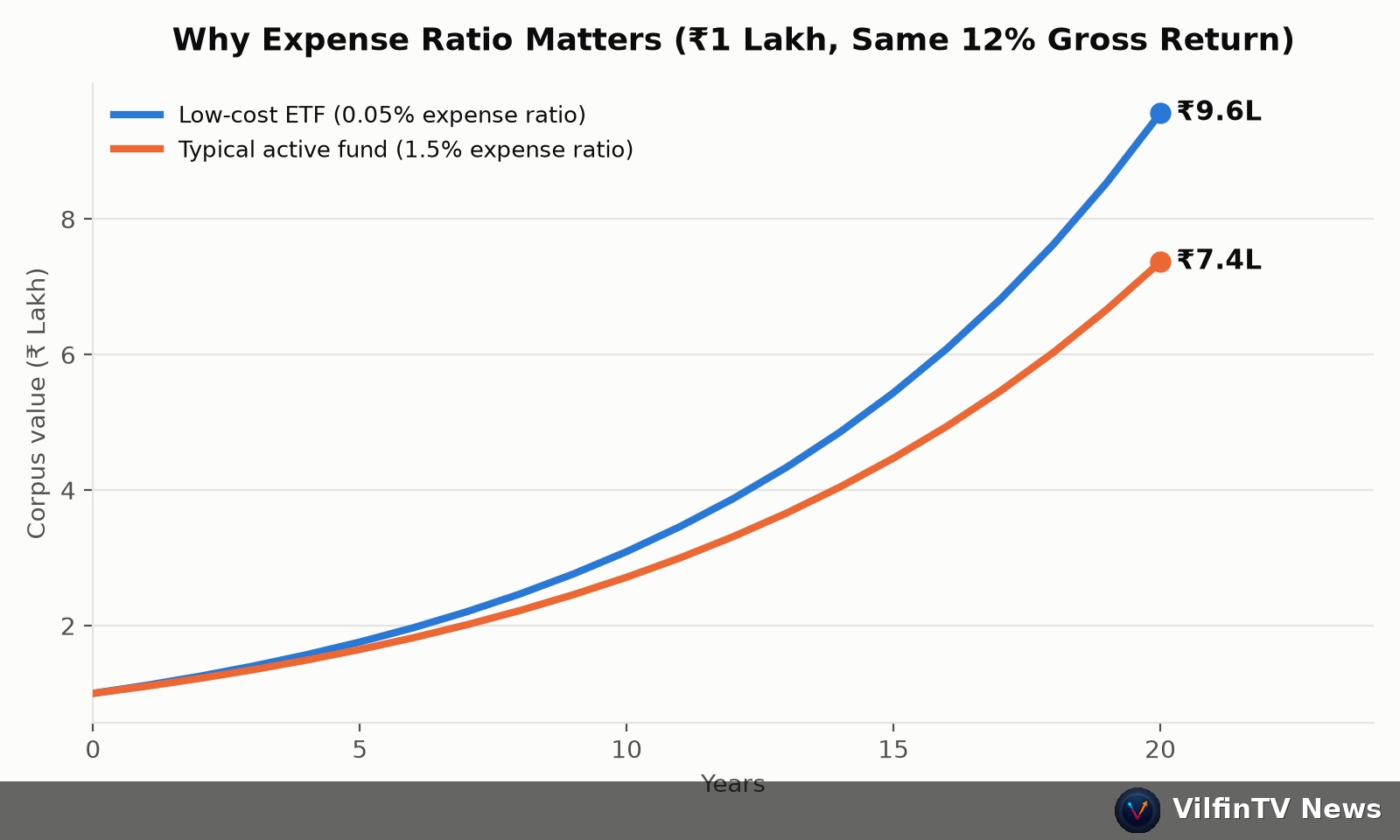
Look at this chart — invest ₹1 lakh once, and after 20 years, an ETF with a 0.05% expense ratio grows to ₹9.6 lakh, while an active fund with a 1.5% expense ratio only reaches ₹7.4 lakh — even with the exact same 12% gross return! (This is purely a mathematical illustration, not a guarantee of future returns.) This is exactly how much a "small fee" compounds into a massive difference over the years — and it's the main reason ETFs and index funds have become so popular.
Benefits: Why Are These Good for Beginners?
- Diversification: One order gets you invested across 50 companies — even if one company does badly, your whole portfolio doesn't collapse.
- Low cost: Since the fund manager isn't personally picking stocks, the expense ratio stays very low.
- No need to study stocks: No research needed on which company to buy.
- Transparency: You always know exactly which stocks are held, at any time.
- Start small: Index fund SIPs can start from as little as ₹100–₹500.
Risks and Limitations
- Market risk: If the index falls, your investment falls too — there's no guarantee protecting your capital.
- Tracking error: The fund tries to copy the index exactly, but a small natural gap (tracking error) always exists.
- Liquidity (ETFs only): Low-trading-volume ETFs can have a wider gap between buy and sell prices — sticking to large, popular ETFs (e.g. NIFTYBEES) is the safer bet.
- It can't "beat" the market: An index fund moves right alongside the market, it never tries to outperform it — that's the whole point of what it is.
How to Get Started: Step by Step
If you want to buy an ETF (via a trading account):
- 1. Open a demat + trading account with Zerodha or Dhan (you'll need PAN, Aadhaar, and bank details).
- 2. Transfer funds into the account.
- 3. Search the ETF ticker in the app (e.g. NIFTYBEES, SBINEQWETF).
- 4. Place your order for the units you want during trading hours (9:15 AM–3:30 PM).
If you want to start an SIP in an index fund:
- 1. Open an account with Kuvera — direct plans, zero commission.
- 2. Complete KYC (one-time, takes just a few minutes).
- 3. Pick an index fund (e.g. ICICI Prudential Nifty 50 Index Fund).
- 4. Choose the "Growth" option and set up a monthly SIP amount (starting from ₹100).
For high-volume traders: Consider ProStocks' flat-fee plan — a flat rate per order makes it more economical for frequent buyers.
🎁 Using the referral links above benefits you at no extra cost.
Further Reading: Related Previous Articles
- Nifty 50 vs Nifty 50 Equal Weight: Which Is Actually Better for Your Money?
- Nifty 50 vs Nifty 50 Shariah: What's the Difference? (Malayalam)
- Nifty Next 50 — India's Next Master Companies (Malayalam)
- Start With ₹500, Grow Into Lakhs: The Mutual Fund Magic Box
- Investing in Mutual Funds & Index Funds via the Navi App (Malayalam)
Conclusion
ETFs and index funds are like a "watch 50 movies on one ticket" deal — you don't need to rack your brain picking each individual movie (stock), just grab the whole combo. You won't get the dividend directly in hand, but it's quietly growing your NAV in the background — a true "silent partner." This is one of the simplest, cheapest, and most long-term-proven paths for beginners — but remember, "easy" doesn't mean "risk-free." Start small, stay invested for the long run, and let the market do the rest!
Disclaimer: This article is for informational and educational purposes only and does not constitute investment advice. Tax rules are subject to change, so please consult a tax expert for current figures, and a licensed financial advisor before making any investment decisions.