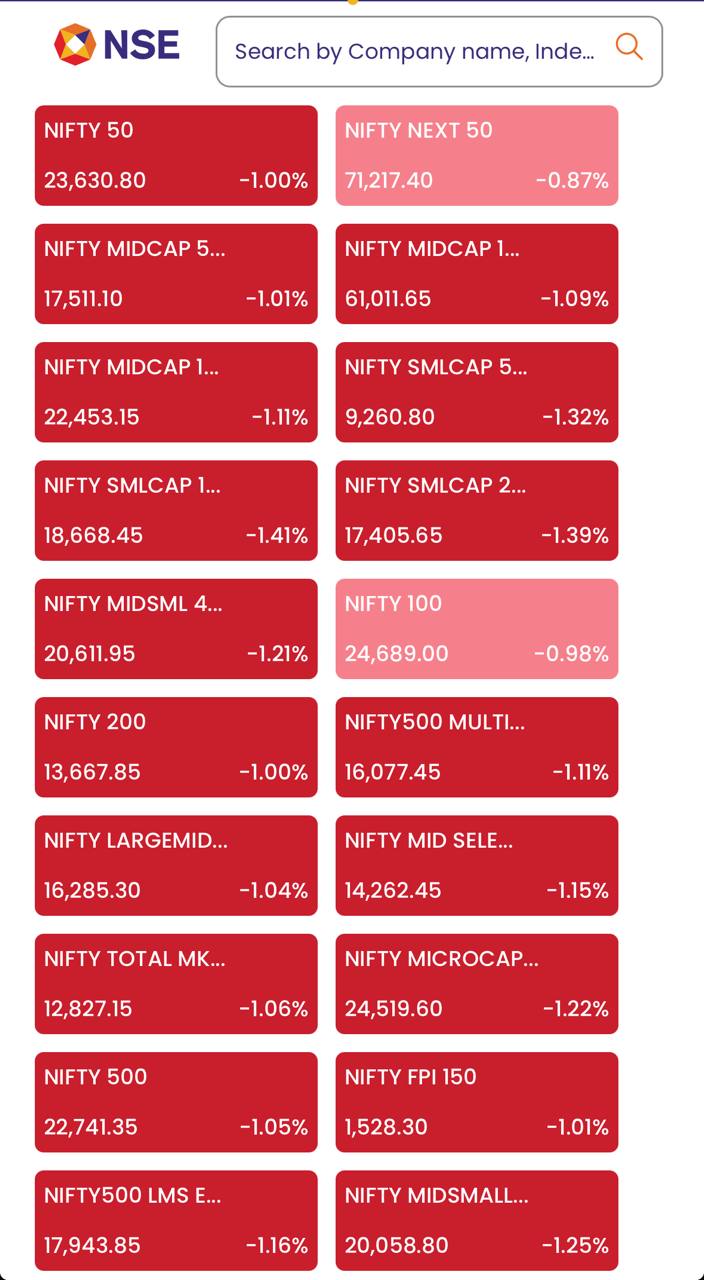
The Day Red Turned the Market Red
It was supposed to be just another Thursday on Dalal Street. By 11 AM, it was anything but.
The NSE opened with a sea of red that only deepened as the morning wore on. Nifty 50 crashed through the 23,700 barrier, Sensex bled over 840 points, and India VIX — the market's fear gauge — shot up over 7% in a single session. Nearly ₹3 lakh crore of investor wealth evaporated in hours.
But the bigger question for every Indian investor right now is not what happened — it's what do I do with my money?
Is this a golden buying opportunity to deploy lump sum? A reason to accelerate SIPs? Or a warning sign to stay in cash and wait?
Let's break down July 24, 2026 — the data, the causes, the technicals, and a clear-eyed forecast — so you can decide with facts, not fear.
📊 The Carnage in Numbers
Data verified across Yahoo Finance, Google Finance, and NSE live feed — all three sources reported consistent numbers within 0.1% variance.
🔥 The 7 Triggers That Lit the Match
1. Crude Oil Near $100 — The biggest culprit. WTI crude hit $92.83 intraday before settling at $91.48, but the psychological damage was done. For a country that imports 85% of its oil, every dollar above $85 eats into corporate margins and widens the current account deficit. News reports across The Economic Times, Business Standard, and ETV Bharat all flagged crude as the primary trigger.
2. Infosys Q1 Miss + Guidance Cut — India's IT bellwether reported disappointing Q1 numbers and slashed its full-year guidance. Shares fell 2%, dragging the entire Nifty IT index down 1.09%. When the sector that contributes 25% of Nifty's earnings stumbles, the whole market feels it.
3. Global Risk-Off Avalanche — The Nikkei 225 crashed 2.97% (nearly 2,000 points). The S&P 500 fell 1.21%, and the Nasdaq lost 2.15%. Japan's selloff was triggered by a stronger yen and disappointing export data — but the contagion spread across Asia within hours, hitting India hardest among emerging markets.
4. FII Selling — Foreign institutional investors have been net sellers in July as global funds rotate out of emerging markets. With the Dollar Index at 101.4 and US 10Y yields at 4.70%, the carry trade advantage for India is narrowing.
5. Rupee Pressure — At 96.51 to the dollar, the rupee is stable for now, but the RBI's ability to cut rates is severely limited. A rate cut — which the market desperately wants — becomes harder when crude and import costs are rising.
6. Realty Selloff (3rd Day) — Nifty Realty fell for the third consecutive session. Housing stocks are sensitive to interest rate expectations, and the market is now pricing out any near-term rate cut from the RBI.
7. VIX Spike — India VIX jumped over 7% to 14.43. While not in panic territory (52-week high was 28.91), this is the highest reading in weeks and signals that options traders are pricing in more downside ahead.
📕 Technical Picture: How Bad Is It Really?
A look at Nifty 50's 30-day chart reveals a market that has been steadily losing altitude, not crashing suddenly.
🔮 Forecast & Strategy: SIP, Lumpsum, or Wait?
Here is the data-driven verdict, not guesswork.
Short-Term (1-2 weeks): ⚠️ More downside likely
The momentum is bearish. Price is below the 20-day SMA, VIX is rising, and global markets are in risk-off mode. The next support is 23,500 — if crude stays above $90 and FIIs keep selling, Nifty could touch 23,200. Do not try to catch a falling knife.
Medium-Term (1-3 months): 📈 Dip-buying opportunity forming
Corrections of 3-5% are healthy in a bull market. India's economic fundamentals — GDP growth, tax collections, manufacturing PMI, and consumption — remain strong. A drop to 23,200-23,500 would make valuations attractive for long-term investors. Historically, every double-digit correction in the last 5 years was followed by a recovery within 3-6 months.
Long-Term (6-12 months): 🟢 Bull case intact
The structural story — formalisation of the economy, capex cycle pickup, digital payments infrastructure, and demographic dividend — hasn't changed. What changed is sentiment, and sentiment is temporary.
🎯 The Verdict: Three Paths Forward
🛠 Actions to Take Right Now
1. Monitor the sentiment live: Bookmark the VilfinTV Market Sentiment Score — it updates every morning with 14+ signals including VIX, yield curve, credit spreads, and equity momentum. Today's score is +30 (Bullish Leaning), suggesting the broader market hasn't turned bearish yet.
2. Review your portfolio allocation: If you're overexposed to IT and Realty, this is a good time to rebalance into Pharma, FMCG, and Energy — defensive sectors are outperforming.
3. Invest via direct mutual funds: Use zero-commission platforms like Navi Mutual Funds for direct plan investments with no commission drag. Even a 1% expense ratio difference compounds to lakhs over 20 years.
4. Diversify into bonds: For fixed-income allocation, explore listed bonds via GoldenPi (use referrer code SRVL1503290). Bond yields are attractive relative to FD rates, and you get monthly/quarterly interest payouts.
🎯 The Bottom Line
Today was a bad day — not a broken market. Nifty lost 204 points, but it's still 7% above its 52-week low and the medium-term economic picture remains intact.
Panic selling is the most expensive mistake an investor can make. Every market crash in history has been followed by a recovery. The investors who made the most money weren't the ones who timed the bottom perfectly — they were the ones who stayed invested through the noise.
If you're a SIP investor, today is a good day. Your ₹10,000 bought more units than it did last week. If you're sitting on cash, don't rush — deploy in tranches and keep powder dry for deeper dips.
The market will recover. It always does.
— VilfinTV Markets Desk · Data verified from Yahoo Finance, Google Finance, NSE live feed