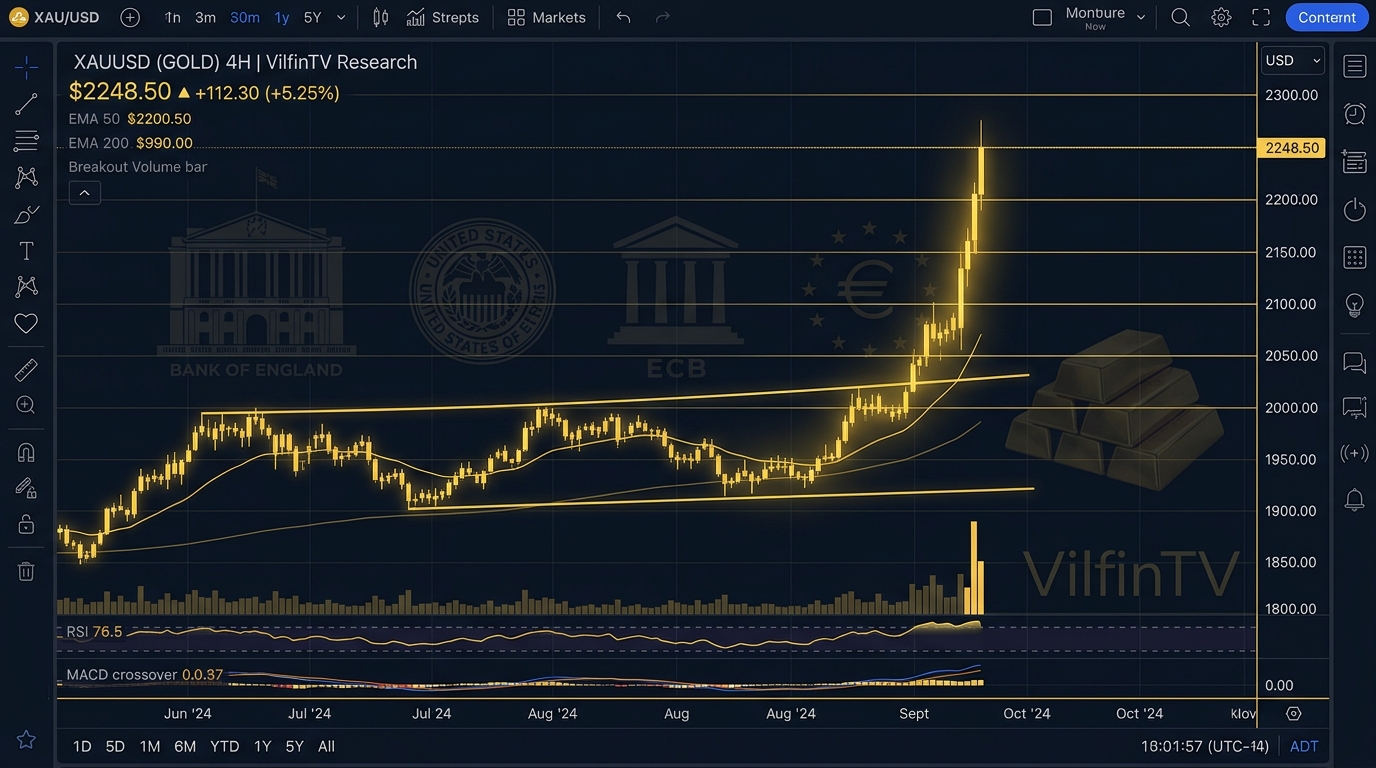
"We are witnessing a structural, once-in-a-decade macroeconomic shift. The global economy is caught in a sovereign debt trap, and the smart money—led by the world's most powerful central banks—is quietly abandoning paper assets for the ultimate tangible anchor: Gold."
The Sovereign Debt Trap: Why Fiat is Faltering
To understand the current gold thesis, we must rewind to 1971, the year the US decoupled the dollar from the gold standard. Since that pivotal moment, fiat currency systems globally have inherently incentivized persistent government deficits. Without a hard anchor, debt-to-GDP ratios have skyrocketed across developed nations.
Today, the macroeconomic environment has reached a boiling point. The US debt is expanding at an unprecedented rate, forcing a severe mathematical dilemma: Either drastically cut spending (politically impossible) or inflate the debt away by debasing the currency. Institutional investors are realizing that relying solely on financial paper assets in a deeply indebted system carries immense, unpriced risk.
Proponents of this supercycle point to the 2002–2011 gold rally as the closest historical analogue. Is this accurate? YES. Between 2002 and 2011, amid the dot-com bust, two wars, and the 2008 Global Financial Crisis, central banks unleashed massive liquidity. Gold surged from roughly $300/oz to over $1,900/oz—a staggering 500%+ return. Today’s setup—sovereign debt saturation, geopolitical fracturing, and impending rate cut cycles—mirrors the exact macroeconomic cocktail that ignited that historic bull run.
The Great Pivot: Central Banks Are Buying, Not Selling
The most compelling argument for gold today isn't coming from retail speculators; it's coming from sovereign nations. Countries like China and India are systematically reducing their exposure to US Treasury debt and aggressively accumulating physical gold reserves. This is a profound shift in global monetary architecture.
- The De-Dollarization Hedge: By holding physical gold, emerging powers protect themselves from weaponized sanctions and fiat currency devaluation.
- The Fed as Buyer of Last Resort: As global demand for US debt wanes, the Federal Reserve may eventually be forced to monetize the debt (act as the buyer of last resort). This would structurally weaken the US Dollar, providing a massive tailwind for dollar-denominated assets like gold.
The Hidden Alpha: Gold Mining Companies
While physical gold acts as a wealth preserver, the true leveraged alpha lies in gold mining stocks. Currently, there is a massive divergence between the underlying commodity price and the valuation of the companies mining it.
As gold prices achieve new all-time highs, the operating margins of top-tier gold miners are expanding dramatically—often outpacing the bloated margins of the broader S&P 500 tech heavyweights. Because mining costs (energy, labor) have somewhat stabilized, every dollar increase in the price of gold falls directly to the bottom line, making mining equities severely undervalued relative to their massive free cash flow generation.
VilfinTV Outlook & Conclusion
The transition from a unipolar, fiat-dominated world to a multipolar, asset-backed environment is messy. In this regime, financial assets (paper) carry counterparty risk, while tangible assets (gold) do not. We are not advocating for a 100% allocation to precious metals, but maintaining a strategic 10-15% portfolio allocation to physical gold or high-quality mining ETFs is no longer just an inflation hedge—it is a mandatory structural insurance policy against a global sovereign debt trap.
Reference: Investment thesis adapted from Alok Jain's macroeconomic breakdown. Watch the full 'Once in a Decade Opportunity' breakdown here.
Don't guess the market direction. Let the data guide you.
Check Daily Market Sentiment Score- 🟢 Zerodha (India)
- 🔥 Dhan (India + US)
- 💹 ProStocks (Flat-fee)
- 🌐 Interactive Brokers (Global)
- 🚀 Kuvera (Mutual Funds)