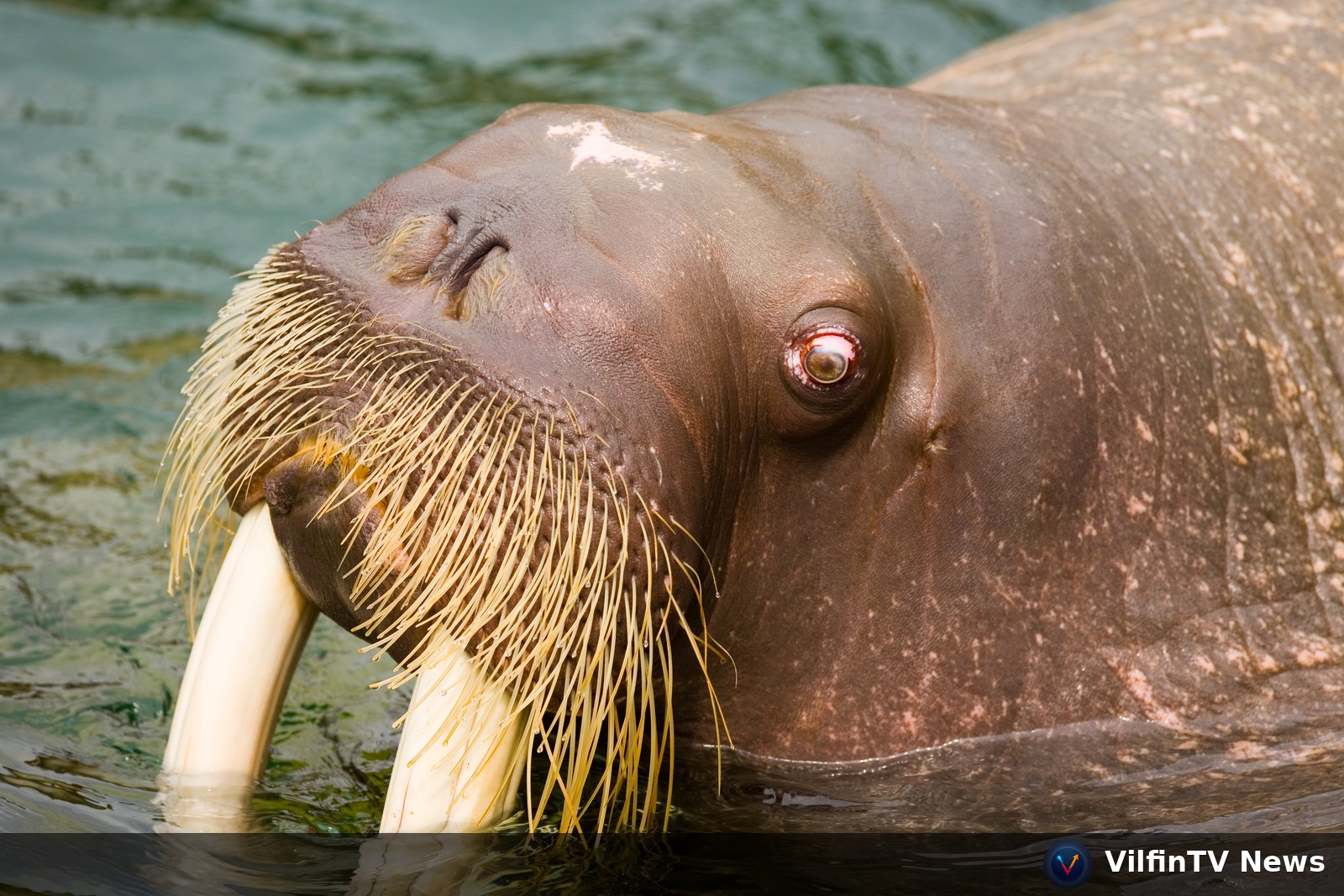
Press the play button on the video above to watch a 720 kg Walrus in action — witness one of the ocean's most surprisingly intelligent giants perform live at an aquarium show.
Seven hundred and twenty kilograms. That is the number on the scale. And yet, somehow, what you are watching is not the lumbering mass of blubber and bone that number might suggest — it is a creature that remembers your face, responds to your voice, solves problems you set in front of it, and performs behaviours of staggering precision on cue from a trainer who has spent years building not a master-servant relationship, but something far more surprising: a friendship. The Walrus — ancient, tusked, pink-skinned, and wildly misunderstood — is among the most cognitively complex animals on the planet. And what aquariums have revealed about its intelligence over the last five decades is nothing short of a scientific revolution.
The Tooth-Walker — Where the Name Comes From
The word "Walrus" arrives in English from the Dutch walrus or walros, but the animal's scientific name — Odobenus rosmarus — is even more revealing. From the ancient Greek: odous (tooth) + baino (to walk) + Latin rosmarus (sea horse). The tooth-walking sea horse. It is a name that describes, with remarkable economy, the Walrus's most famous behaviour: using its enormous ivory tusks to haul itself up and out of the Arctic ocean onto ice floes, anchoring the tusk tips into ice or rock as a fifth limb, and levering the body upward in a motion that no other marine mammal on Earth replicates.
Those tusks — which can reach one metre in length in large males and grow continuously throughout the animal's entire life — are the defining visual signature of the species. They are made of dentine and enamel, structurally identical to elephant ivory, and have made the Walrus one of the most heavily hunted animals in Arctic history. For centuries, the tusks were the only reason most humans cared about the Walrus at all. What lay behind them — inside the animal's mind — went almost entirely unexplored.
The Numbers — A Body Built for Extremes
| Fact | Detail |
|---|---|
| Scientific Name | Odobenus rosmarus — "tooth-walking sea horse" |
| Adult Male Weight | 800 – 1,700 kg |
| Adult Female Weight | 400 – 1,250 kg |
| Body Length | 2.2 – 3.6 metres |
| Tusk Length (males) | Up to 1 metre; grows throughout life |
| Lifespan | 30 – 40 years in wild |
| Dive Depth | Up to 80 metres; heart slows to ~4 bpm |
| Vibrissae (whiskers) | Up to 450 individual whiskers; primary hunting tool |
| Primary Diet | Clams, molluscs, sea cucumbers, crustaceans |
| Global Population | ~230,000 (Pacific + Atlantic subspecies) |
| IUCN Status | Vulnerable |
720 Kilograms — What That Actually Means
The Walrus in this aquarium show weighs 720 kilograms. To put that in any frame of reference that does justice to the number: this is heavier than a grand piano. Heavier than a fully loaded motorbike with five passengers. Heavier than most cars that rolled off assembly lines before 1980. And this animal is moving with fluency and precision through trained behavioural sequences that would challenge the recall and coordination of most human athletes.
The skin that holds all of that together is extraordinary in itself. Walrus skin can reach 4 centimetres thick — a natural armour that protects the animal in combat, against the ice edges it hauls itself over, and against the biting cold. Beneath the skin lies a thick layer of blubber that can account for up to 30% of total body weight, providing both thermal insulation in sub-zero water and a long-term energy reserve for the months when food is scarce.
And then there is the colour — because the Walrus is not always the brown or grey animal most people picture. When a Walrus is cold, in Arctic water, its peripheral blood vessels constrict to preserve core temperature, and the skin turns a pale, ghostly white or grey. When a Walrus hauls itself out onto ice and warms in sunlight, those same vessels dilate dramatically, flooding the skin with blood, and the animal turns a vivid, unmistakable pink. A 720-kilogram animal turning pink in real time is one of the stranger things the natural world offers.
The Whisker That Changed Everything — How the Walrus Hunts
For most of the last century, marine biologists assumed the Walrus hunted the way most large predators hunt: by sight. The assumption was reasonable. Hunting by vision is efficient in clear water. It is what seals do. It is what dolphins do.
It is not what the Walrus does. And the discovery of the actual mechanism — made in detail only in the late 20th century — is one of the most extraordinary sensory stories in all of zoology.
The Walrus hunts almost entirely by touch. Specifically, by the 400 to 450 highly sensitive, stiffened whiskers — called vibrissae — that cover its muzzle in a dense pad. These are not like the facial whiskers of a cat or dog. Each individual Walrus vibrissa is innervated with nerve endings at a density that rivals the human fingertip — perhaps the most sensitive biological touch surface in any marine mammal. The Walrus plunges this whisker pad into the ocean floor sediment and sweeps it systematically through the mud and gravel, feeling for the subtle shape and texture of individual clam shells buried beneath the surface. In total darkness, in zero-visibility Arctic water, a Walrus can locate, excavate, and process up to 6,000 clams in a single feeding dive. Not by seeing them. By feeling them. One at a time. In the dark.
The whiskers you see on the aquarium Walrus's face are not decorative. They are, gram for gram, one of the most sophisticated sensory instruments possessed by any animal on Earth.
The Sleeping Buoy — The Trick That Defies Physics
One of the least-known Walrus behaviours is also one of the most physically improbable: the Walrus can sleep in open ocean water, floating upright, without drowning. It does this using a pair of inflatable pharyngeal pouches — air sacs in its throat that can hold up to 50 litres of air. When fully inflated, these pouches act as a natural life jacket, keeping the animal's head above water even during deep sleep. A Walrus can sleep in the ocean for hours, its 700-kilogram body suspended at the surface by nothing but internal air bags, while its heart rate and metabolic processes slow dramatically to conserve energy.
No other pinniped — the group that includes seals, sea lions, and walruses — does this. It is a behavioural and anatomical adaptation unique to the Walrus, developed over millions of years of life in an environment where solid ice to haul out on is not always available, but rest is always necessary.
Hoover, NOC, and the Walrus That Talked — The Intelligence Files
The most famous case study in Walrus intelligence is an animal that never performed a single aquarium show. His name was Hoover, and he lived at the New England Aquarium in Boston from 1971 until his death in 1985. Hoover was a Harbour seal, not a Walrus — but his story opened the door to a broader investigation of pinniped cognition that would eventually transform what researchers understood about the entire group, Walruses included.
Hoover produced sounds that were unmistakably human in cadence and structure — not imitation, but genuine phonemic mimicry of the Boston English dialect spoken by his human caretakers. The sounds included phrases, greetings, and what appeared to be deliberate attempts at communication. His case, combined with parallel findings in Beluga whales and bottlenose dolphins, convinced the scientific community that vocal mimicry in marine mammals was not an isolated quirk but a systematic feature of a broader cognitive profile: the ability to learn, categorise, and reproduce novel sound patterns.
Subsequent work on Walruses specifically has confirmed a parallel picture. Captive Walruses demonstrate object permanence (understanding that an object continues to exist when hidden from view — a cognitive milestone that human infants reach at around 8 months). They demonstrate delayed imitation — watching a human perform an action, waiting, and reproducing it minutes or hours later. They show clear individual recognition of human faces across years, distinguishing between dozens of different people. And they show social learning — one Walrus watching another perform a novel behaviour and adopting it without direct reinforcement.
The animal in this aquarium show is not performing because it was forced to, or because it has no choice. It is performing because the training programme built a relationship over months and years in which the correct behaviour was rewarded, the animal retained what it learned, and the trainer and Walrus developed a working vocabulary of signals and responses that represents one of the most complex inter-species communication systems achieved outside of great ape research.
The History of the Hunt — And Why It Matters Now
For most of the last five centuries, the Walrus was not considered a subject of scientific fascination. It was considered a commercial resource. Its ivory tusks were carved into decorative objects and traded across Europe and Asia. Its blubber was rendered into oil for lamps, lubrication, and leather tanning. Its hide was used for ropes, boat coverings, and harnesses. Its meat fed entire human communities through Arctic winters.
Commercial hunting — particularly by Russian, Norwegian, and American vessels from the 17th through the early 20th centuries — reduced Atlantic Walrus populations by an estimated 50 to 70 percent before international protections halted the commercial harvest. The Pacific Walrus population, estimated at approximately 200,000 animals today, is believed to be substantially lower than its pre-commercial-hunting baseline.
The Walrus's current status on the IUCN Red List is Vulnerable — not Endangered, but under active pressure from a threat that no amount of protective legislation can directly control: the loss of Arctic sea ice driven by climate change. Walruses depend on sea ice for resting between dives, for giving birth, for nursing calves, and for accessing feeding grounds in shallow Arctic waters. As sea ice retreats northward into deeper water, Walruses are forced to haul out on land instead — in massive, dangerously overcrowded aggregations called haulouts — where the risk of stampede-related mortality, particularly among calves, increases dramatically. In a documented haulout at Point Lay, Alaska, over 35,000 Walruses gathered on a single beach — a consequence of the ice they would normally rest on having melted entirely.
Why the Aquarium Show Is Part of the Answer
The objection to marine mammal aquarium programmes is real, and it is not frivolous: an animal of this size, intelligence, and social complexity did not evolve for captivity, and the ethical obligations of institutions that keep these animals are serious, ongoing, and subject to legitimate scientific debate.
The counter-argument — equally real, equally serious — is what happens in the minds of the people watching. Visitor studies at marine animal facilities consistently find that direct, close-range encounter with a large, intelligent marine animal produces measurable changes in attitude toward ocean conservation that are qualitatively different from, and substantially stronger than, those produced by watching the same species on a television screen. The Walrus in the tank is enormous, present, clearly intelligent, and demonstrably an individual. It is not a data point in a news story about melting ice. It is a specific animal, with a specific face, with specific preferences, and a specific trainer who knows its name.
That specificity — the irreducible particularity of the encounter — is what transforms concern into commitment. The question is not whether this Walrus is best served by captivity. The question is whether the 230,000 Walruses in the wild are best served by a world in which no human has ever stood close enough to one to feel something personal about its survival. The aquarium's answer — and the evidence, carefully examined, tends to support it — is no.
Conclusion — The Weight of What We're Watching
Seven hundred and twenty kilograms. A brain the size of a large grapefruit. Whiskers that can find a single clam in pitch-black Arctic sediment. Air sacs that keep the body afloat during hours of open-ocean sleep. Tusks that grow for decades and carry the history of a life's worth of conflicts and climbs. A memory that holds human faces across years. A vocal apparatus capable of mimicking patterns it has never naturally produced.
This is the animal in the aquarium show. Not a curiosity. Not a trick. Not a spectacle in the diminishing sense of that word.
A portrait of 23 million years of evolution — the Walrus lineage diverged from its closest relatives in the Miocene epoch — compressed into the space of a pool, rendered visible by the patience of a trainer and the extraordinary cognitive flexibility of an animal that was built for ice and darkness but has demonstrated, repeatedly and under rigorous study, that it can learn, remember, communicate, and adapt in ways that the humans who hunt and warm its world have consistently underestimated.
Press play. Watch carefully. And remember: what you are about to see weigh 720 kilograms is, by any reasonable scientific definition, thinking.