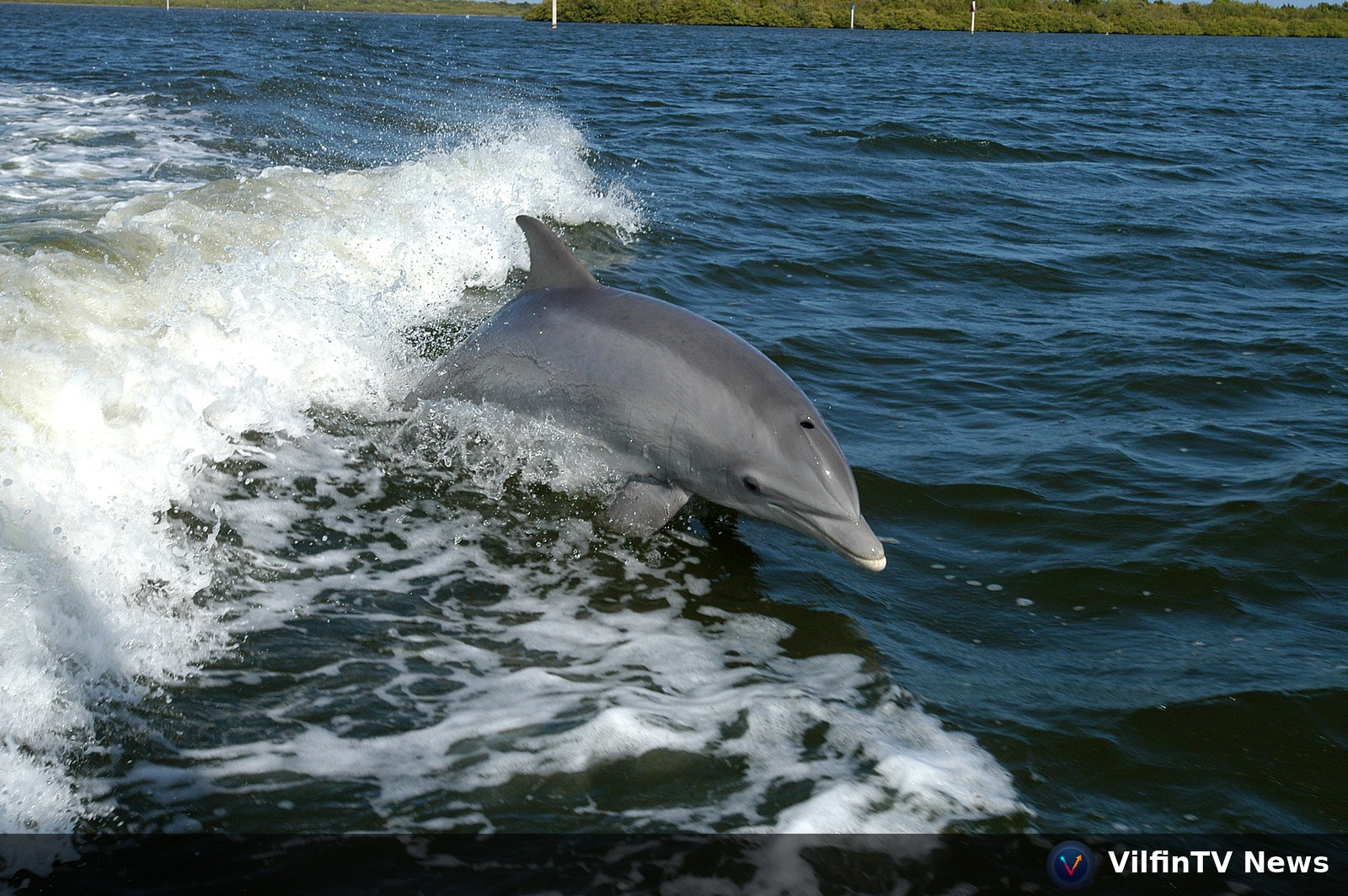
Press the play button on the video above to watch a spectacular live Dolphin performance at Yokohama Hakkeijima Sea Paradise — breathtaking leaps, spins, and the astonishing intelligence of Earth's most social ocean animal on full display.
It happens in an instant. A grey curve of muscle erupts from the surface, catching air and light simultaneously. The body twists — once, twice — then re-enters the water in a line so clean it barely disturbs the surface. Before the ripples have settled, a second dolphin breaks through. Then a third. The crowd catches its breath. Not because the acrobatics are impressive, though they are. But because there is something undeniably, uncomfortably familiar in what you are watching: a creature that is not performing for you, not exactly — it is performing with you, reading the room, adjusting, aware. The Bottlenose Dolphin, in the seven decades since it first shared a pool with a human being, has forced science to revise almost everything it believed about animal intelligence. And what it has revealed in the process is one of the most confronting truths in modern biology: we are not nearly as cognitively alone in this ocean world as we assumed.
Yokohama's Stage — The Aquarium That Changed Japan's Relationship with the Sea
When the Yokohama Hakkeijima Sea Paradise opened on March 18, 1993, built on entirely reclaimed land in the bay south of the city, it introduced a generation of Japanese visitors to something that could not be conveyed by a nature documentary or a school textbook: proximity. The aquarium's dolphin stadium — one of the centrepieces of the facility's Aqua Resorts complex — was designed not to let visitors watch dolphins from a safe, contained distance, but to create the conditions under which a genuine encounter between two intelligent species could take place.
The Hakkeijima dolphin programme has, over three decades, become one of the most visited marine animal shows in Asia. What draws people back is not repetition. It is the opposite of repetition: the subtle variation, the unmistakable responsiveness, the moments when a dolphin breaks from the scripted sequence and does something the trainer didn't cue — and the trainer laughs, because they expected this, because the animal they are working with is creative. You cannot script creativity. You can only create conditions where it is safe for it to emerge.
Who Is the Bottlenose Dolphin — The Numbers First
| Fact | Detail |
|---|---|
| Scientific Name | Tursiops truncatus — "curved-nose dolphin" |
| Adult Weight | 150 – 650 kg |
| Adult Length | 2 – 4 metres |
| Wild Lifespan | 40 – 60 years (females live longer) |
| Dive Speed | Up to 35 km/h sustained; burst to 54 km/h |
| Echolocation clicks | Up to 1,000 clicks per second |
| Brain-to-Body Ratio | Second only to humans among all animals |
| Gestation | 12 months; single calf, nursed for 3–6 years |
| Pod Size | 2–15 typical; aggregations of hundreds documented |
| Habitat | All oceans; temperate to tropical; coastal and open water |
| IUCN Status | Least Concern (overall population) |
The Brain That Changed Everything
To understand what makes the dolphin cognitively distinctive, you need to understand its brain — not as a metaphor, but as a physical object. The bottlenose dolphin brain weighs approximately 1,500 to 1,700 grams. The adult human brain weighs approximately 1,300 to 1,400 grams. The dolphin brain is, on average, larger than a human brain.
Size alone means little — an elephant brain weighs 5,000 grams, and elephants are intelligent but not cognitively superior to humans in most tested domains. What matters is the ratio of brain size to body size (called the encephalisation quotient, or EQ) and the complexity of the brain's surface architecture. On the EQ measure, dolphins rank second among all animals ever studied. Only humans score higher. On the complexity measure — the degree of surface folding, called gyrification, which increases the area of the brain's cortex — dolphin brains are highly gyrified, with folding patterns that in some ways exceed those of human brains. The architecture is different from ours. The cognitive outcomes it produces, studied systematically since the 1960s, are extraordinary.
The Mirror Test — The Day Dolphins Proved Self-Awareness
In 1970, the psychologist Gordon Gallup Jr. developed what has become the most widely used test for self-awareness in non-human animals: the mirror test. The procedure is straightforward. Mark an animal's body with a visible dye in a spot the animal cannot directly see (typically the forehead). Then place the animal in front of a mirror. An animal that lacks self-awareness will either ignore the mirror or treat its reflection as a separate animal. An animal that is self-aware will recognize the reflection as itself, and attempt to investigate or touch the mark — a behaviour that requires an abstract understanding of the sentence "that image is me."
When Gordon Gallup first developed the test, only great apes passed it. For thirty years, no non-primate species was documented passing the mirror test. Then, in 2001, the researchers Diana Reiss and Lori Marino published a landmark study in the journal Proceedings of the National Academy of Sciences: bottlenose dolphins pass the mirror test. They had been the first non-primate species confirmed as self-aware by experimental standard. The finding was not universally accepted immediately — it never is, in science — but it has since been replicated and extended. Dolphins do not merely recognise themselves in mirrors. They use mirrors to inspect parts of their bodies they have never been able to see directly. They are curious about their own appearance in a way that implies a concept of self that extends beyond the immediate moment.
The Name That No One Taught Them — Signature Whistles
In 2013, a research team led by the marine biologist Victor Janik at the University of St Andrews published a finding that generated headlines around the world: dolphins call each other by name. Each individual bottlenose dolphin develops a unique, signature whistle in the first few months of life — not inherited from parents, not copied from pod-mates, but individually invented. This whistle is the dolphin's identifier, functioning in the same way a name does in human language. Dolphins address each other using these signature whistles. When they are separated from a pod member, they call the missing animal's signature whistle. When a signature whistle is played back through an underwater speaker, the named dolphin approaches the speaker and vocalises — responding, recognisably, to its name being called.
No other non-human animal has been documented doing this. The behaviour implies not only individual identity, but a social cognitive framework that understands other individuals as having persistent, named identities — a conceptual structure that underpins almost every form of human social organisation from language to law.
The Tool Users — A 200-Year-Old Culture
In Shark Bay, Western Australia, a population of bottlenose dolphins has been observed carrying marine sponges in their beaks while foraging on the ocean floor. The sponge protects the dolphin's sensitive beak from the sharp rocks and spines of the sandy bottom. This is tool use — one of the cognitive milestones long considered a defining characteristic of human intelligence.
What makes the Shark Bay sponge behaviour truly remarkable is its cultural dimension. The technique is passed down from mothers to daughters across generations. A 2005 genetic study confirmed that the sponge-carrying dolphins in Shark Bay are almost all female, and that the behaviour is transmitted through maternal lineage, not through genetic inheritance. This is culture in the technical sense: learned behaviour transmitted through social teaching across generations, independent of genetics. The sponge-carrying tradition in Shark Bay is estimated to be at least 200 years old — and possibly much older, since the first European observers documented it without recognising its significance.
Sleep Without Stopping — The Unihemispheric Brain
Dolphins cannot stop moving to sleep. Unlike land mammals — including humans — who lose motor control during sleep, a dolphin that became fully unconscious would stop swimming, sink, and drown. The evolutionary solution is one of the most elegant in all of neuroscience: unihemispheric sleep. When a dolphin sleeps, one hemisphere of its brain enters a slow-wave sleep state while the other hemisphere remains fully awake, maintaining respiration, navigation, and basic motor function. After a period, the hemispheres switch. The dolphin sleeps, in total, but never loses consciousness entirely.
During unihemispheric sleep, the eye connected to the sleeping brain hemisphere closes. The eye connected to the awake hemisphere remains open. A sleeping dolphin, observed from the water's surface, appears to have one eye open and one eye closed — watching you, even in sleep, with half a brain that is fully alert. In research contexts, dolphins in unihemispheric sleep have been documented maintaining simple vigilance tasks — tracking moving objects, avoiding obstacles — with the awake hemisphere while the sleeping hemisphere rests. The performance of a half-asleep dolphin on some attention tasks matches the performance of a fully awake human.
The History of Dolphins and Humans — From Myth to Mirror
The Ancient World (3000 BCE – 1700 CE)
The dolphin appears in human culture earlier than almost any other marine animal. Minoan frescoes from 1600 BCE show dolphins alongside human figures in scenes that imply familiarity and cohabitation. Ancient Greek mythology describes dolphins as sacred to Apollo and Poseidon — divine intermediaries between the human world and the sea. The Greek historian Plutarch, writing in the 1st century CE, recorded accounts of dolphins forming long-term bonds with specific children in coastal towns, returning to the same beaches year after year to interact with the same individuals. Modern marine biologists, reviewing these accounts, note that the described behaviours — including the use of signature vocalisations to identify specific humans — are entirely consistent with what we now know about dolphin cognition.
The Aquarium Era (1938 – 1980s)
The first bottlenose dolphins were displayed in a marine park setting in 1938, at Marine Studios in St Augustine, Florida — later renamed Marineland. The facility was designed primarily as an underwater filming studio, not a public aquarium, but the dolphins it housed proved immediately and overwhelmingly popular with visitors. By the 1950s and 1960s, dolphin shows had spread to marine parks across North America, Europe, and Japan. The 1964 television series Flipper — featuring a bottlenose dolphin as a central character with evident cognitive complexity and emotional depth — reached audiences of 30 million per episode and transformed the dolphin from a curiosity into a cultural icon.
The Science Decades (1960s – Present)
The popularisation of dolphin shows coincided with the first serious scientific investigation of dolphin cognition. The neuroscientist John Lilly — controversial, often wrong in the specifics but right about the scale of the problem — published Man and Dolphin in 1961, arguing that dolphins possessed a form of intelligence comparable to human intelligence. His specific claims were later disputed, but his broader point — that the dolphin brain demanded serious scientific attention — proved entirely correct. The decades of research that followed established, step by step, the picture of cognitive complexity that is now a scientific consensus: self-awareness, cultural transmission, individual naming, theory of mind, numerical cognition, and a social intelligence that rivals that of great apes.
The Threats They Face — And What the Performance Means
The global bottlenose dolphin population is not endangered as a whole. But specific populations face specific pressures that illuminate a broader crisis in ocean health.
The Maui's dolphin of New Zealand — a subspecies of Hector's dolphin closely related to the bottlenose — has fewer than 54 individuals remaining, making it the world's rarest marine dolphin. The Baiji, or Yangtze River dolphin, was declared functionally extinct in 2006 — the first cetacean species driven to extinction by human activity, and the first large vertebrate to be lost since the Caribbean monk seal in the 1950s. Its disappearance from the world was confirmed not by a dramatic event but by absence: researchers searched the Yangtze River for six weeks and found nothing. The species that had inhabited that river for 20 million years was simply gone.
For the surviving dolphin populations, the threats are ongoing: bycatch in fishing nets remains the leading cause of dolphin mortality globally. Persistent organic pollutants — particularly PCBs and DDT derivatives — accumulate in dolphin blubber across a lifetime and are transferred to calves through mother's milk, impairing immune function and reproduction. Ocean noise from shipping traffic and sonar interferes with the echolocation and communication systems on which dolphins entirely depend. Climate change is altering the distribution of prey species, forcing dolphins to travel farther for food and disrupting breeding cycles tied to ocean temperature.
Against this backdrop, what happens at Hakkeijima Sea Paradise — and at marine facilities like it worldwide — is not separate from the conservation story. It is part of it. The research conducted with captive dolphins over the last seven decades has produced most of what we know about dolphin cognition, communication, and biology. Without that knowledge, the conservation arguments for protecting wild populations would be significantly weaker, because we would not understand what, precisely, is being lost when a dolphin population declines.
What the Leap Actually Is
The aerial leap you see in the Hakkeijima performance — the full-body breach that clears the water by two metres or more — is not merely a trained behaviour. It is an amplified version of something dolphins do spontaneously in the wild. Wild dolphins breach for documented reasons: to shake off skin parasites, to stun fish, to signal to distant pod members, and — in a finding that continues to divide researchers — apparently for the simple reason that they enjoy it. Captive dolphins whose training sessions are deliberately ended early, denying them the opportunity to perform a behaviour they have been working toward, show signs of frustration that are behaviourally distinct from neutral states. Dolphins that are given free time in their pools — unstructured time with no training, no feeding reward, no human interaction — often perform voluntary leaps and complex acrobatic sequences with no external reinforcement at all.
The science of what is happening in those moments is not fully resolved. But the leading interpretation — consistent with everything else we know about dolphin cognition — is that a species of this intelligence does not perform elaborate, energetically expensive physical behaviours purely by accident. It does them because doing them is, in whatever sense this word applies to a non-human mind, satisfying.
Conclusion — The Intelligence at the Surface
In the water of the Hakkeijima dolphin pool, something moves at 35 kilometres per hour, reads the angle of your body, responds to a hand signal smaller than a postcard, and then decides — on its own, unreinforced, unscripted — to add one more spin to the leap because it can.
Sixty years of research have produced a scientific consensus that would have seemed extraordinary to any biologist working before 1970: the bottlenose dolphin is self-aware, culturally sophisticated, individually named, tool-using, capable of numerical reasoning, and possessed of a social intelligence that, in its operational complexity, approaches and in some domains equals our own.
We share this planet with an animal that knows its own face. That calls its companions by name. That teaches its children skills accumulated over two centuries. That grieves. That plays. That, when given a mirror, looks into it and understands — with a brain that is, by several measures, more elaborate than ours — that it is looking at itself.
The performance at Yokohama Hakkeijima Sea Paradise is spectacular. But the spectacle is not the point. The point is recognition — and what it demands of us in return.