You feel tired. You feel foggy. You feel like your body is dragging itself through the day on half a battery. And most people blame stress, sleep, or screens. But here's the brutal truth nobody talks about — you might simply be running out of iron.
Iron deficiency is the most common nutritional deficiency on the planet. Over 1.6 billion people worldwide are affected. And the terrifying part? Most of them have no idea. The symptoms creep in slowly — fatigue, weakness, pale skin, brittle nails, difficulty concentrating — until one day your body just refuses to perform.
The good news? The fix is sitting right on your plate. Let's break it all down.
🩸 Why Iron Is Not Optional
Iron is the engine behind your blood. Every red blood cell in your body carries a tiny molecule called haemoglobin — and haemoglobin is built from iron. Without enough iron, your blood literally cannot carry oxygen efficiently. Every muscle, every organ, every thought you have depends on oxygen delivery. Cut that supply and everything suffers.
Your body needs 8mg of iron per day if you're a man, and a staggering 18mg per day if you're a woman of reproductive age. Pregnant women need even more — up to 27mg daily. Yet the average diet consistently falls short. The gap between what you need and what you eat is where exhaustion lives.
🥩 The Animal Kingdom's Iron Powerhouses
Let's start with the heavyweights — because when it comes to iron per 100g, animal sources don't play around.
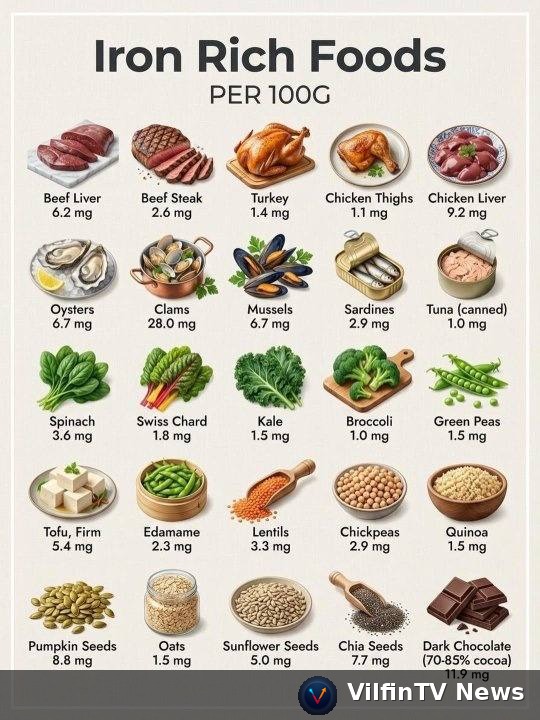
Clams lead the entire list with a jaw-dropping 28.0mg per 100g. Nothing else comes close. A single serving of steamed clams can meet your daily iron requirement twice over. Mussels (6.7mg) and oysters (6.7mg) aren't far behind — and they bring along zinc and B12 as bonus nutrients.
Chicken liver delivers 9.2mg per 100g — nearly matching a full day's requirement for men in one small serving. Beef liver comes in at 6.2mg. Organ meats have a strong flavour, but no other food packs this density of iron alongside vitamin A, folate, and copper. If you can stomach it twice a week, your iron levels will thank you for life.
For everyday meals, beef steak gives you 2.6mg per 100g. Not as dramatic as liver, but real, practical, and paired with the most bioavailable form of iron that exists — heme iron. Your body absorbs heme iron (from animal foods) at a rate of 15–35%, far superior to plant sources. Sardines (2.9mg) and tuna (1.0mg) are solid seafood options for mid-week variety.
🌿 The Plant Warriors Fighting Quietly
If you're vegetarian or simply cutting back on meat, the plant kingdom has your back — but you need to know how to use it properly.
Spinach packs 3.6mg per 100g and has been a symbol of strength for decades — Popeye wasn't entirely wrong. Pair it with lemon juice or tomatoes and the vitamin C dramatically boosts your body's absorption of its non-heme iron. Swiss chard (1.8mg) and kale (1.5mg) round out the dark leafy green brigade — eat them raw in salads or lightly wilted with garlic.
Lentils are the quiet champion of plant proteins with 3.3mg per 100g. They're cheap, fast to cook, endlessly versatile, and culturally embedded in cuisines across India, the Middle East, and the Mediterranean. Add chickpeas (2.9mg) and edamame (2.3mg) and you have a legume strategy that builds iron levels meal by meal.
Tofu (firm) surprises everyone at 5.4mg per 100g — making it one of the strongest plant-based sources on the list. A daily tofu stir-fry, done right, gives you real, measurable iron. Quinoa at 1.5mg per 100g is modest but delivers complete protein alongside, making it a functional grain swap over white rice.
🌰 The Dark Horse Champions: Seeds & Chocolate
Here's where it gets surprising. The foods most people snack on carelessly happen to be iron bombs in disguise.
Dark chocolate (70–85% cocoa) hits 11.9mg per 100g. That's not a typo. A 30–40g square of quality dark chocolate is a legitimate iron source. It also brings magnesium and antioxidants. This is not permission to eat the entire bar — but it is permission to enjoy it guilt-free.
Pumpkin seeds deliver 8.8mg per 100g — extraordinary for a tiny seed you can scatter on anything. Roast them with salt and keep them in a jar by the kitchen. Chia seeds come in at 7.7mg per 100g and dissolve into smoothies, puddings, and overnight oats without changing flavour. Sunflower seeds at 5.0mg are another effortless daily habit — toss them into a salad, a stir-fry, or eat them straight.
Oats at 1.5mg per 100g might seem modest but consider this — if you eat oats every morning with chia seeds, pumpkin seeds, and spinach at lunch, you are building a consistent, powerful daily iron intake without even trying hard.
⚡ The Absorption Secret Nobody Tells You
Eating iron-rich foods is only half the battle. The other half is making sure your body can actually absorb what you eat.
Vitamin C is your best friend. It converts non-heme iron (from plants) into a form your gut can absorb up to three times more efficiently. A glass of orange juice with your lentil dal. Lemon squeezed on spinach. Bell peppers with tofu. These combinations work. They are not accidents — they are biology.
Calcium is your enemy at mealtimes. Dairy products, if consumed at the same time as iron-rich foods, actively block iron absorption. Save your milk, yoghurt, and cheese for different meals or snacks, not alongside your iron sources.
Tea and coffee block iron too. The tannins in both drinks bind to iron and carry it out of your system before it can be absorbed. Wait at least an hour after an iron-rich meal before reaching for your cup.
📋 Your Daily Iron Blueprint
You don't need supplements. You need a strategy. Here's a practical daily framework that quietly builds iron levels over weeks:
- Breakfast: Oats with chia seeds, pumpkin seeds, and a glass of fresh orange juice
- Lunch: Lentil or chickpea dish with spinach and a squeeze of lemon
- Snack: A square of dark chocolate (70%+) or a small handful of sunflower seeds
- Dinner: Grilled beef, chicken liver, tofu, or seafood (clams, sardines, mussels) — with broccoli or kale on the side
- Avoid: Tea, coffee, or dairy immediately after iron-rich meals
Follow this consistently for four to six weeks. Most people notice a visible difference in energy, mental clarity, and physical endurance before a blood test even confirms the improvement.
✅ The Bottom Line
Iron is not a supplement you add when things go wrong. It is a daily foundation you build through food — deliberately, consistently, and smartly. The foods are accessible, affordable, and delicious. The absorption rules are simple. The results are real.
Stop waiting for exhaustion to diagnose you. Start building your iron intake today — one meal at a time.
Health Disclaimer: This article is for general informational and educational purposes only. The iron content values cited are approximate figures per 100g of food and may vary based on preparation method and source. Individual nutritional needs differ based on age, health status, and medical history. If you suspect iron deficiency or anaemia, please consult a qualified healthcare professional before making significant dietary changes or starting supplementation. Do not self-diagnose or self-treat based on this content.