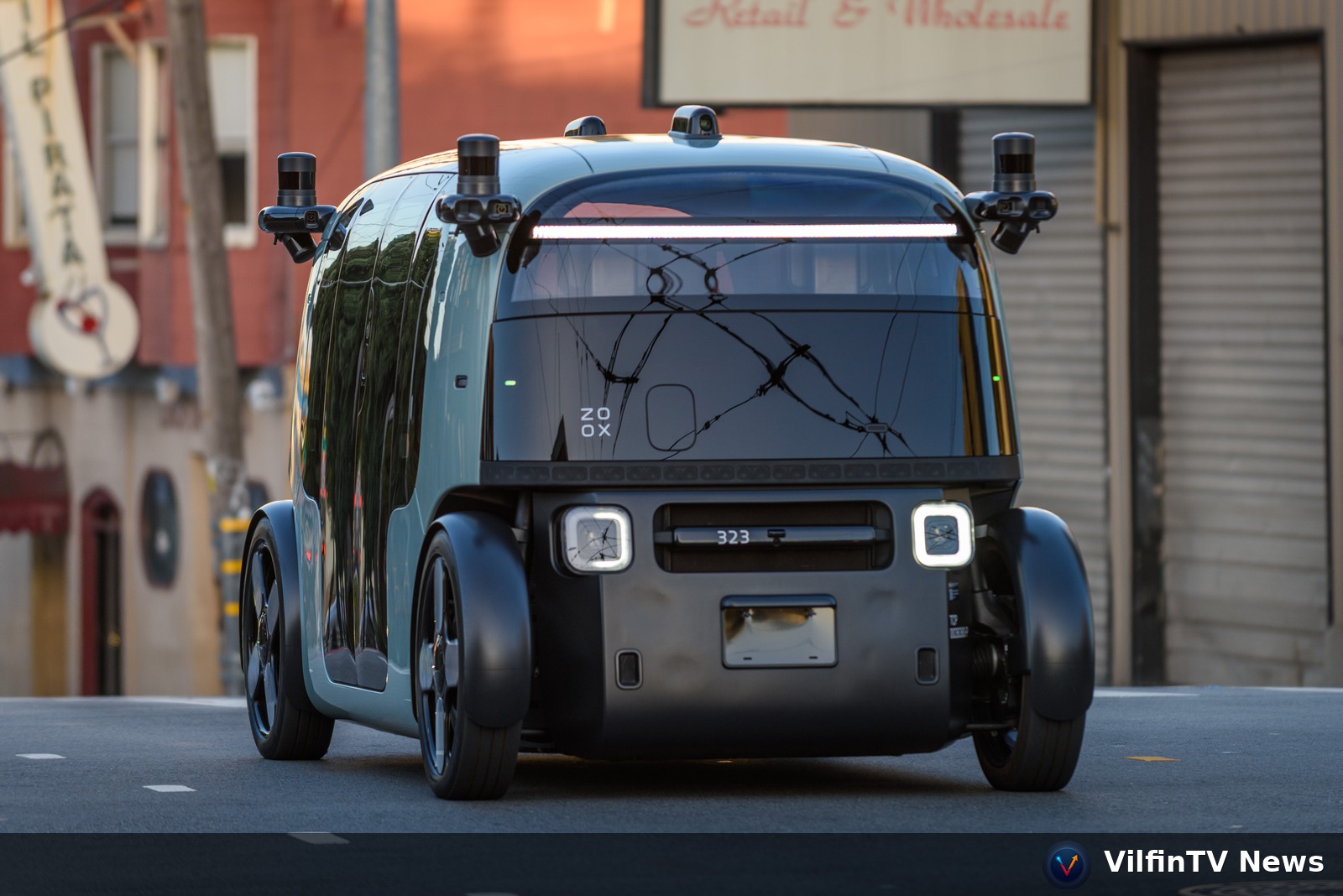
On August 10, 2026, something that had been science fiction for decades became mundane reality on the Las Vegas Strip. A car with no steering wheel, no pedals, and no driver pulled up, opened its doors, and charged a passenger real money for the ride. Amazon's Zoox had officially turned on the meter — and in doing so, became the first company in the United States to collect commercial fares in a fully driverless vehicle that was purpose-built from the ground up as a robotaxi.
This was not a converted car. It was not a Toyota with a camera bolted on top. Zoox built its vehicle from a blank sheet of paper, starting with the question every other automaker forgot to ask: what should a taxi look like if no human ever drives it? The answer is a symmetrical, bidirectional pod — no front, no back, no mirrors — with four adult passengers sitting face-to-face in a cabin that looks more like a luxury train compartment than anything with wheels. It drives equally well in both directions. It never needs to reverse. And until three days ago, it had never charged anyone a single dollar.
Two Years in the Making — and One Historic Exemption
The commercial launch didn't happen by accident. On July 30, 2026, the US National Highway Traffic Safety Administration (NHTSA) granted Zoox the first-ever commercial exemption for a purpose-built robotaxi — a two-year permit covering up to 2,500 vehicles across eight federal safety standards that assume a human driver exists. Standards like windshield defrost and light-vehicle braking are written for machines with steering wheels. Zoox's vehicle has neither, so it needed a waiver. After years of lobbying, testing, and one very public software recall (105 vehicles pulled in July after a robotaxi drove into a heavy smoke zone from a nearby fire), NHTSA said yes.
CEO Aicha Evans called it "the first-ever commercial exemption for a purpose-built robotaxi." The Trump administration went further, publicly naming Zoox a "frontrunner" in the robotaxi race. Within eleven days of that exemption, the meter was running.
How the Fare Works
Zoox prices like a premium ride-hail service — base charge plus per-mile and per-minute components, locked in at booking even if the route changes. The company says fares land in the "comfort" tier, roughly 20–40% above standard ride-hail rates. Destination surcharges for high-traffic venues like the Sphere and T-Mobile Arena are disclosed upfront. You book through the Zoox app. There is no surge pricing negotiation, no driver to tip, and no small talk.
What you get instead: a cabin redesigned based on feedback from 500,000 free riders who tested it since the Las Vegas Strip launch in September 2025. Monochrome aloe-green seating. Stone-grey flooring. Larger cupholders. Brighter touchscreens. And on the outside — color-rotating bidirectional reflectors so pedestrians can tell which end is which, plus a two-way speaker and microphone on the door so the car can literally talk to people in its path.
The Uber Deal Nobody Fully Appreciated
In March 2026, Zoox quietly signed a multiyear partnership with Uber — making Zoox rides bookable directly inside the Uber app in Las Vegas, with Los Angeles expansion planned for mid-2027. On the surface it looked like a distribution deal. In practice it was Zoox solving one of its hardest problems: getting people to open a new app. By riding inside Uber's network, Zoox immediately gains access to millions of users who already have payment details entered, habits formed, and trust established. Uber called it part of its $10 billion autonomous vehicle commitment. Analysts called it the move that validates Zoox's strategy of building the vehicle and letting someone else own the demand.
Scale — and the Gap to Close
Zoox's production-intent factory in Hayward, California can currently build 100 vehicles per week. The NHTSA exemption caps the commercial fleet at 2,500 vehicles over two years — meaning Zoox could theoretically fill that cap in just 25 weeks of full production. The real constraint is permitting: San Francisco and Austin remain free-ride markets while Zoox waits for additional regulatory clearances. Las Vegas is the only paid-fare zone today.
Waymo, the Google subsidiary and current US robotaxi market leader by miles driven, operates a larger fleet — but in retrofitted passenger vehicles (Jaguar I-PACE, Zeekr). Zoox is the first to bet that a purpose-built vehicle, designed entirely around the absence of a driver, is the only way to win the next decade. Amazon paid $1.2 billion for that bet in June 2020. Six years later, the first dollar is in.
The question now is not whether autonomous taxis work. It is how fast Zoox can scale from 2,500 permitted vehicles to the kind of fleet that makes the economics irreversible. On the Strip in Las Vegas, that clock is already ticking.