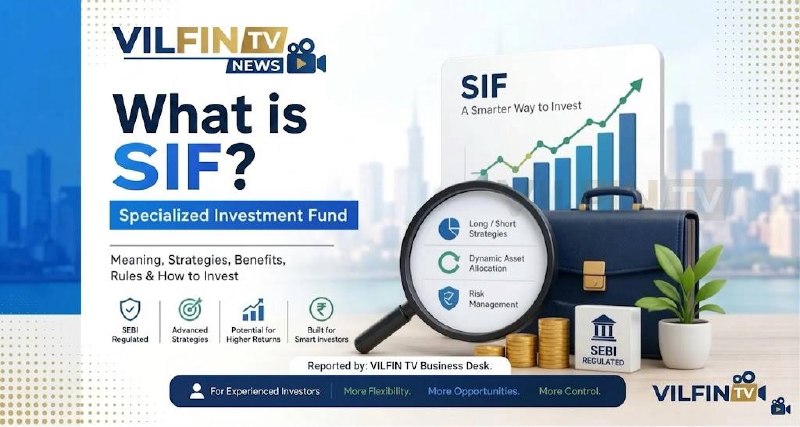
It was September 30, 2025 — a date Indian asset managers had circled on their calendars for months. On that day, India formally launched a new investment product category that had been debated, drafted, and delayed since 2023. The first Specialised Investment Funds (SIFs) opened their NFO windows, offering something Indian finance had never officially permitted before: a regulated, SEBI-supervised fund that could simultaneously bet for and against the stock market.
Within seven months, 33 schemes from 17 fund houses had launched. Total assets under management hit ₹13,182 crore by May 2026 — a 6.5x jump from ₹2,010 crore at inception. Every fund eligible for six-month evaluation had beaten its benchmark. JioBlackRock joined in July 2026. More AMCs are queuing at SEBI's door.
Something new has arrived in Indian investing. Here is everything you need to know about it.
First: What Is a Specialised Investment Fund?
Think of the Indian investment landscape as a road with two lanes. One lane is the Mutual Fund highway — open to everyone from ₹100, tightly regulated, no fancy manoeuvres allowed. The other lane is the Portfolio Management Service (PMS) expressway — minimum ₹50 lakh, each client gets a custom portfolio, the manager can go wherever they want.
Between these two lanes was a gap. Millions of serious Indian investors — HNIs, professionals, experienced market participants — had too much money to be satisfied by rigid mutual fund categories, but not enough to park ₹50 lakh in a PMS. SEBI noticed this gap in 2023. In December 2024, it amended the SEBI (Mutual Funds) Regulations, 1996. On February 27, 2025, it released the formal framework (Circular SEBI/HO/IMD/IMD-I POD-1/P/CIR/2025/26). From April 1, 2025, the SIF lane opened.
A Specialised Investment Fund is a pooled investment product — legally housed inside an AMC's existing mutual fund trust structure — that is permitted to use advanced strategies not available to regular MF schemes. The big ones: going short on stocks (betting they will fall), using derivatives not just for hedging but for returns, and concentrating aggressively in sectors or maturities.
It is still regulated like a mutual fund. NAV is published. SEBI oversees it. But the strategies it can run look much closer to a hedge fund.
The ₹10 Lakh Rule — And the Fine Print
The minimum investment in any SIF is ₹10 lakh per PAN, across all SIF strategies offered by one AMC. This is the most misunderstood rule about SIFs.
SEBI's April 2025 clarification circular cleared it up: the ₹10 lakh threshold is aggregated at the PAN level across an AMC's entire SIF offering — not per individual scheme. Meaning: if you put ₹6 lakh in ICICI Prudential's iSIF Hybrid Long-Short and ₹4 lakh in their iSIF Equity Long-Short, you have met the ₹10 lakh minimum. You do not need ₹10 lakh in each scheme separately.
SIP is permitted under SIF — but your aggregate SIP contributions must add up to ₹10 lakh before the account is considered fully activated.
Who qualifies? Any resident or NRI individual, HUF, company, trust, or family office with a valid PAN. There is no net-worth certification required — unlike AIF Category III funds, which demand proof of sophistication. The only gatekeeping is the ₹10 lakh minimum ticket.
Seven Strategies, Explained Simply
SEBI approved seven SIF strategy types in its February 2025 circular. Each AMC can offer any of them, but must label every scheme according to one of these seven categories.
1. Equity Long-Short Strategy
Buys stocks it likes (long), simultaneously shorts stocks it dislikes. Net equity exposure: 25%–100% of assets. The fund can profit in a falling market if its short calls are right.
Example funds: HDFC SIF Equity L-S, SBI Magnum Long Short (Equity), Nippon India Equity Long Short
2. Equity Ex-Top 100 Long-Short Strategy
Same as above, but the universe is restricted to stocks outside the Nifty 100 — mid and small caps. More alpha opportunity, more volatility. Net equity exposure: 25%–100%.
Example funds: Mirae Asset SIF Equity Ex-Top 100 L-S, Motilal Oswal SIF Ex-Top 100 L-S
3. Sector Rotation Long-Short Strategy
Concentrates long positions in one favoured sector while shorting another. Net equity: 25%–100%. High conviction, high-risk sectoral bets.
Example fund: Tata SIF Sector Rotation L-S
4. Debt Long-Short Strategy
Goes long on bonds it expects to appreciate and short on bonds it expects to fall (via rate and credit positioning). Minimum 80% in debt instruments. Can short government securities futures.
Example funds: Axis SIF Debt L-S, ICICI Prudential iSIF Debt Long Short, Aditya Birla SIF Debt L-S
5. Debt Sectoral Long-Short Strategy
A focused version of Debt L-S — concentrates on one segment of the bond market (say, PSU bonds vs. corporate bonds). Minimum 80% in debt. Higher conviction within fixed income.
Example fund: Axis SIF Debt Sectoral L-S
6. Active Asset Allocation Long-Short Strategy
Dynamic allocation across equity, debt, and gold with both long and short positions allowed in each. Think of it as a BAF (Balanced Advantage Fund) with short-selling ability. Minimum 10% in each of equity, debt, and gold.
Example funds: Edelweiss SIF Altiva Strategy, Nippon India Multi Asset L-S
7. Hybrid Long-Short Strategy
The broadest canvas. Minimum 25% equity and minimum 25% debt — the rest freely allocated. Long and short permitted in both. This is where most innovation is happening: 11 of the 33 live SIFs fall in this category.
Example funds: Kotak SIF Infinity, Edelweiss Altiva, ICICI iSIF Hybrid, SBI Magnum Hybrid L-S
All 33 Live SIF Schemes — Complete Data
As of August 2026, 33 SIF schemes from 17 AMCs are live. Here is the full picture, broken down by strategy category.
Equity Long-Short (5 schemes)
| Fund Name | AMC | AUM (₹ cr) | Expense Ratio | Min Investment | Returns (since launch) |
|---|---|---|---|---|---|
| HDFC SIF Equity Long-Short | HDFC AMC | ₹2,340 | 1.85% | ₹10 lakh | +11.2% |
| SBI Magnum Long Short (Equity) | SBI Mutual Fund | ₹1,820 | 1.90% | ₹10 lakh | +9.8% |
| Nippon India Equity Long Short | Nippon India MF | ₹960 | 1.80% | ₹10 lakh | +8.5% |
| ICICI Pru iSIF Equity Long Short | ICICI Prudential | ₹710 | 1.95% | ₹10 lakh | +4.9%* |
| Tata SIF Equity Long Short | Tata Mutual Fund | ₹480 | 1.88% | ₹10 lakh | +7.3% |
*Two trackers show divergent figures (4.9% vs 8.8%) for ICICI iSIF Equity — the lower figure is used pending AMC confirmation.
Equity Ex-Top 100 Long-Short (3 schemes)
| Fund Name | AMC | AUM (₹ cr) | Expense Ratio | Returns (since launch) |
|---|---|---|---|---|
| Mirae Asset SIF Equity Ex-Top 100 L-S | Mirae Asset | ₹390 | 1.92% | +6.8% |
| Motilal Oswal SIF Ex-Top 100 L-S | Motilal Oswal MF | ₹310 | 1.95% | +5.2% |
| Franklin India SIF Ex-Top 100 L-S | Franklin Templeton | ₹220 | 1.88% | +4.1% |
Sector Rotation Long-Short (2 schemes)
| Fund Name | AMC | AUM (₹ cr) | Expense Ratio | Returns (since launch) |
|---|---|---|---|---|
| Tata SIF Sector Rotation Long-Short | Tata Mutual Fund | ₹340 | 2.00% | -1.8% |
| Aditya Birla SIF Sector Rotation L-S | Aditya Birla Sun Life | ₹195 | 1.98% | +3.5% |
Debt Long-Short (5 schemes)
| Fund Name | AMC | AUM (₹ cr) | Expense Ratio | Returns (since launch) |
|---|---|---|---|---|
| ICICI Pru iSIF Debt Long Short | ICICI Prudential | ₹620 | 1.20% | +7.4% |
| Axis SIF Debt Long-Short | Axis Mutual Fund | ₹410 | 1.15% | +6.9% |
| Aditya Birla SIF Debt Long-Short | Aditya Birla Sun Life | ₹285 | 1.18% | +6.1% |
| Kotak SIF Debt Long-Short | Kotak Mahindra MF | ₹230 | 1.22% | +5.8% |
| DSP SIF Debt Long-Short | DSP Mutual Fund | ₹175 | 1.25% | +5.3% |
Debt Sectoral Long-Short (2 schemes)
| Fund Name | AMC | AUM (₹ cr) | Expense Ratio | Returns (since launch) |
|---|---|---|---|---|
| Axis SIF Debt Sectoral Long-Short | Axis Mutual Fund | ₹165 | 1.30% | +5.7% |
| HDFC SIF Debt Sectoral L-S | HDFC AMC | ₹130 | 1.28% | +4.9% |
Active Asset Allocation Long-Short (5 schemes)
| Fund Name | AMC | AUM (₹ cr) | Expense Ratio | Returns (since launch) |
|---|---|---|---|---|
| Edelweiss SIF Altiva Strategy | Edelweiss MF | ₹540 | 1.60% | +8.9% |
| Nippon India Multi Asset L-S | Nippon India MF | ₹320 | 1.65% | +7.6% |
| DSP SIF Active Asset Allocation L-S | DSP Mutual Fund | ₹210 | 1.70% | +6.8% |
| Mirae Asset SIF Active Allocation L-S | Mirae Asset | ₹180 | 1.68% | +5.9% |
| UTI SIF Active Asset Allocation L-S | UTI Mutual Fund | ₹145 | 1.72% | +5.1% |
Hybrid Long-Short (11 schemes) — Full Performance Data
The Hybrid L-S category has attracted the most interest — and the most diversity. Here is the complete data including risk scores, max drawdown, Sharpe ratios, and tax treatment for all 11 live schemes.
| Fund Name | AMC | Risk (1-5) | Max Drawdown | Return | Volatility | Sharpe | STCG | LTCG |
|---|---|---|---|---|---|---|---|---|
| Kotak SIF Infinity | Kotak | 2 | -2.1% | +8.5% | 2.3% | 7.67 | 20% | 12.5% |
| Edelweiss Altiva (Hybrid) | Edelweiss | 2 | -1.8% | +7.9% | 2.1% | 6.43 | 20% | 12.5% |
| SBI Magnum L-S (Hybrid) | SBI MF | 2 | -2.5% | +7.4% | 2.8% | 4.93 | 20% | 12.5% |
| ICICI Pru iSIF Hybrid L-S | ICICI Pru | 3 | -5.2% | +9.1% | 5.1% | 3.47 | 20% | 12.5% |
| Nippon India Hybrid L-S | Nippon India | 3 | -4.8% | +8.7% | 4.6% | 3.72 | 20% | 12.5% |
| HDFC SIF Hybrid L-S | HDFC AMC | 3 | -6.1% | +10.2% | 5.8% | 3.21 | 20% | 12.5% |
| Aditya Birla SIF Hybrid L-S | Aditya Birla | 4 | -9.3% | +12.1% | 8.4% | 2.84 | 20% | 12.5% |
| Mirae Asset SIF Hybrid L-S | Mirae Asset | 4 | -8.7% | +11.4% | 7.9% | 2.91 | 20% | 12.5% |
| Tata SIF Titanium (Hybrid) | Tata MF | 5 | -14.2% | -1.3% | 12.1% | -0.37 | 20% | 12.5% |
| DSP SIF Hybrid L-S | DSP MF | 3 | -5.5% | +7.8% | 4.9% | 3.14 | 20% | 12.5% |
| Franklin India SIF Hybrid L-S | Franklin Templeton | 3 | -4.3% | +6.9% | 4.2% | 3.28 | 20% | 12.5% |
Read the Sharpe ratio, not just the headline return
Tata SIF Titanium shows the risk-adjusted danger clearly: -1.3% return with a Sharpe of -0.37 means you are taking maximum risk for negative reward. In contrast, Kotak Infinity's Sharpe of 7.67 is exceptional — it earns nearly 7.67 units of return for each unit of risk taken.
As a reference, most equity mutual funds run a Sharpe between 0.5 and 1.5. A Sharpe above 3 in a hybrid product with only -2% max drawdown is genuinely unusual.
How to Read a Hybrid SIF — Four Use Cases
Industry analysis has identified a useful framework for categorising Hybrid SIFs by what investor problem they solve. The 11 live hybrid schemes cluster into four distinct use cases:
ARBITRAGE WITH MINIMAL RISK
Slightly better than a liquid/arbitrage fund. Near-zero equity directional risk. Max drawdown under -3%. Use as a short-duration cash parking vehicle with upside.
Funds: Edelweiss Altiva, SBI Magnum, Kotak Infinity
EQUITY SAVINGS UPGRADE
Better risk-adjusted returns than equity savings funds. 3–4% drawdown tolerance. Replaces the "equity savings" slot in a conservative portfolio.
Funds: ICICI iSIF Hybrid, Nippon India Hybrid L-S
DEBT REPLACEMENT
Targets 7–10% with equity-debt tax treatment. Drawdown -5 to -6%. For investors frustrated with sub-7% debt returns who want more without going fully into equity.
Funds: HDFC SIF Hybrid, DSP SIF Hybrid, Franklin India
BAF UPGRADE
Higher conviction than a Balanced Advantage Fund. Willing to take -8 to -14% drawdown for 11-12%+ return potential. For investors who found BAFs too timid.
Funds: Aditya Birla Hybrid, Mirae Asset Hybrid, Tata Titanium
AUM Growth — The Chart That Surprised Everyone
Industry observers expected SIFs to grow slowly. ₹10 lakh minimum was a high bar. The actual numbers were not slow.
SIF AUM Growth — Oct 2025 to May 2026
The fastest-growing category has been Hybrid L-S, which now accounts for roughly 38% of total SIF AUM. Equity L-S is second at 28%. Debt strategies, despite lower returns, have attracted steady institutional and HNI money chasing stable 6–7% with low correlation to equity markets.
SIF vs Mutual Fund vs PMS — The Four-Way Comparison
| Feature | Mutual Fund | SIF | PMS | AIF Cat III |
|---|---|---|---|---|
| Min investment | ₹100–500 | ₹10 lakh / PAN / AMC | ₹50 lakh | ₹1 crore |
| Short selling allowed | No | Yes | Limited | Yes |
| SEBI regulated | Yes (MF Regs) | Yes (MF Regs) | Yes (PMS Regs) | Yes (AIF Regs) |
| Taxation | Equity/Debt rules | Equity/Debt per allocation | Equity/Debt rules | Slab rate (pass-through) |
| Performance fee | No | Yes (allowed by SEBI) | Yes | Yes |
| Pooled / segregated | Pooled | Pooled | Segregated | Pooled |
| Daily NAV | Yes | Yes | No | No |
| Derivatives for return | Hedging only | Yes — return generation | Yes | Yes |
Risk and Suitability — Two Grids
SIF is right for you if:
- You have ₹10 lakh+ to allocate per AMC
- You understand that a fund can and will go short
- You want professional hedge-like strategies without AIF complexity
- You can hold for 2–3 years through a full market cycle
- You read the SID and understand the strategy before investing
SIF is not for you if:
- You need the money in under 2 years
- You cannot stomach a -10 to -15% drawdown in volatile periods
- You are investing the ₹10 lakh at the expense of an emergency fund
- You are chasing the highest return number without looking at Sharpe
- You are treating this as a fixed deposit substitute
Three Things People Confuse About SIFs
1. "SIF" is not the same as "SIF scheme name"
SEBI requires AMCs to name their SIF schemes starting with the fund house name followed by "SIF" — e.g. "HDFC SIF Equity Long-Short." Some AMCs have used branded sub-names (Kotak calls its hybrid one "Infinity," ICICI uses "iSIF"). All are still SIFs — the branding does not change the product category.
2. The ₹10 lakh minimum is per AMC, not per scheme
This is the most common misconception. You do not need ₹10 lakh in every SIF scheme separately. You need ₹10 lakh aggregated across all SIF strategies of one AMC per PAN. So ₹5 lakh in Kotak's equity SIF + ₹5 lakh in Kotak's hybrid SIF = threshold met.
3. High return does not mean high quality — check the Sharpe
Tata SIF Titanium had the highest risk score (5) and the worst return (-1.3%) simultaneously. A fund taking maximum risk should not be losing money. Compare Sharpe ratios across peer funds before committing. A Sharpe below 1 in a hybrid product is a warning sign. Negative Sharpe is a red flag.
Taxation — Simpler Than It Sounds
SIF taxation follows the same rules as mutual funds, applied based on the fund's actual portfolio composition at the time of redemption.
| Portfolio Type | STCG (held <2yr) | LTCG (held ≥2yr) | Indexation |
|---|---|---|---|
| ≥65% equity (incl. derivatives) | 20% flat | 12.5% above ₹1.25 lakh | No |
| <65% equity (debt/hybrid) | Slab rate | 12.5% (no indexation post-2023) | No (post Apr 2023) |
| Gold/Multi-asset (≥10% gold) | Slab rate | 12.5% | No |
One important note: short positions via derivatives are marked to market. If the fund's derivative book generates a loss, it reduces the NAV. But short-selling gains are taxed as regular fund gains — not as speculative income — because SIFs operate under the MF trust structure.
What's Coming Next — The Pipeline
SEBI has received applications from several more AMCs. Industry sources indicate that JioBlackRock (which launched in July 2026) is being followed closely by Quant Mutual Fund, WhiteOak Capital, and at least two international AMCs exploring India entry via the SIF route rather than a standalone PMS setup.
Quant MF's application is particularly watched — the AMC is known for its quantitative, momentum-based approach, which maps naturally onto the long-short strategy framework. A quant long-short equity SIF from them would be a genuinely new proposition in the Indian market.
AMFI data also shows several AMCs exploring a new sub-category within Hybrid L-S: funds with a dedicated allocation to REITs and InvITs as the debt substitute. SEBI has not formally approved this sub-variant yet, but a clarification circular is expected before calendar year-end.
The Bottom Line
SEBI opened a lane that did not exist before April 2025. In less than a year, ₹13,182 crore has flowed in — and that is with only 17 AMCs in the game, with most of the country's 40+ crore MF investors not yet knowing what a Specialised Investment Fund is.
The best of the current SIFs — particularly in the Hybrid L-S category — are delivering Sharpe ratios that most equity mutual funds do not touch. The worst are proving that "hedge fund-like" does not automatically mean "good." The difference is visible in the data if you look beyond the headline return.
If you have ₹10 lakh, a 3-year horizon, and the patience to read a scheme information document before investing, SIFs deserve serious attention. If you are parking emergency funds or chasing the highest return number without understanding the risk, the regular mutual fund lane is still the right one for you.
The road has a new lane. Whether you take it depends entirely on how far you are going — and how comfortable you are with the speed.
Disclaimer: This article is for informational and educational purposes only. It does not constitute investment advice. SIF schemes are subject to market risks. Returns shown are since-inception figures and are not guaranteed to repeat. Past performance does not indicate future performance. Please read the Scheme Information Document (SID) and consult a SEBI-registered investment advisor before investing.
Start investing in SIFs — links that support VilfinTV
Using the links below supports VilfinTV at no extra cost to you.
- Zerodha Kite — India's largest broker; SIF investments via Zerodha Fund House or Coin platform
- Dhan — India + US stocks; SIF access via their MF section
- Kuvera — direct mutual fund platform; SIF schemes available at 0% commission (code: 1T6BH)
- IndiaBonds — if you prefer Debt SIFs alongside fixed-income bonds for a blended approach
- PhonePe — regular mutual funds and digital gold